Agentic Marketplace: How Agent2Agent Protocol Enables Cross-Company AI Collaboration
AI Business: The Rise of the “Agentic Marketplace” via A2A
🔑 Key Takeaways
- The Agent2Agent protocol (A2A) enables secure AI agent collaboration across companies
- The future of B2B AI strategy is modular, not monolithic
- Cross-company AI workflows unlock new revenue models and ecosystem partnerships
- Google Cloud AI and other enterprise platforms are accelerating interoperable agent frameworks
- Agentic marketplaces allow specialized agents to “hire” other agents dynamically
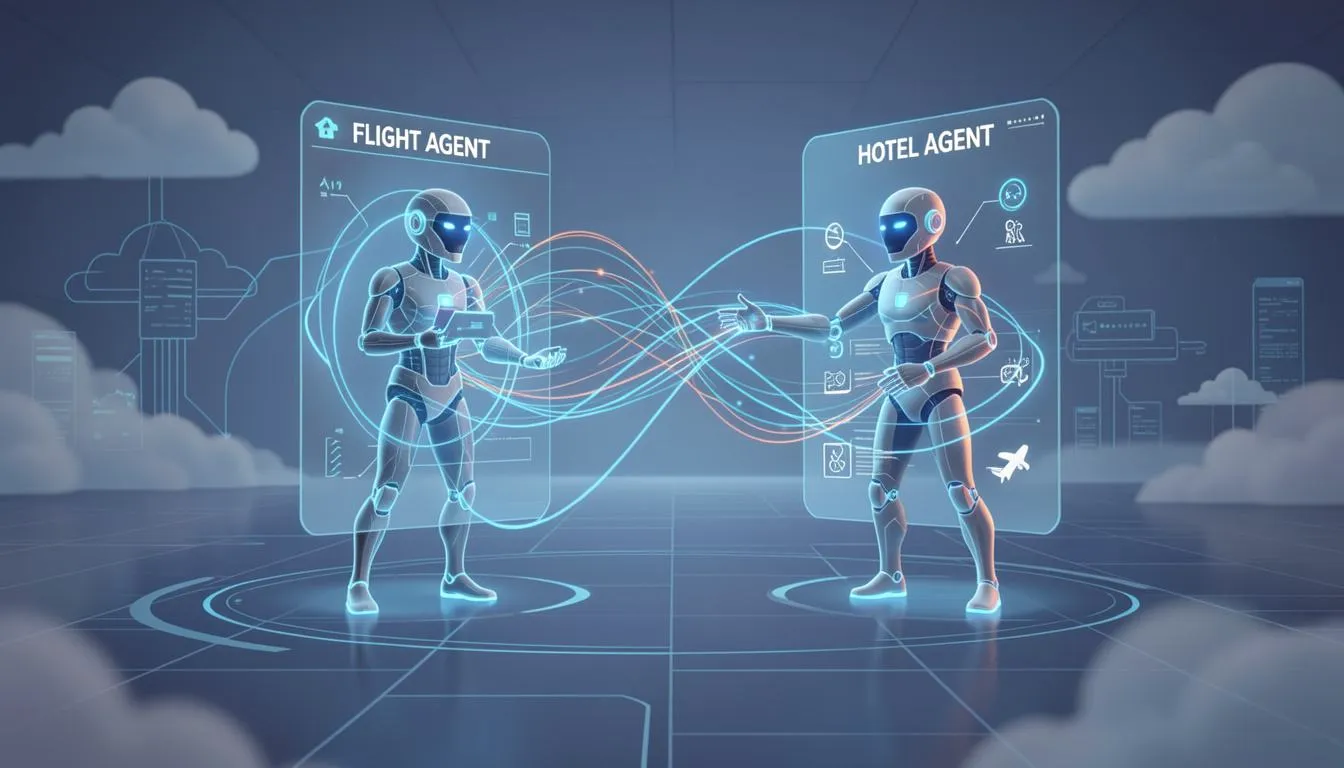
- Case Study: The Travel Coordination Scenario shows how a Flight Agent can discover and contract a Hotel Agent in real time
What If Your AI Didn’t Have to Do Everything?
For years, SaaS companies chased the same dream:
Build the all-in-one platform.
Own the full stack.
Control the entire customer journey.
But AI changes that equation.
As a CTO or product manager, you’ve likely faced this dilemma:
Do we build every capability internally…
or integrate with others and lose control?
Now imagine a third option.
What if your AI agent could collaborate with other companies’ AI agents — securely, dynamically, and intelligently — to deliver better outcomes than any single system could alone?
Welcome to the rise of the Agentic Marketplace.
The Core Problem: Monolithic AI Is Unsustainable
Most current B2B AI strategy discussions revolve around:
- Bigger models
- Broader feature sets
- Deeper vertical integration
But that approach has limits.
Trying to build a “perfect” AI that handles:
- Flights
- Hotels
- Insurance
- Payments
- Customer support
…inside one company quickly becomes unmanageable.
It creates:
- Engineering sprawl
- Slow innovation cycles
- Bloated infrastructure costs
- Compromised specialization
If ignored, this leads to stalled roadmaps and diluted differentiation.
The future doesn’t belong to generalists.
It belongs to specialists that can collaborate.
Enter A2A: The Agent2Agent Protocol
The :contentReference[oaicite:0]{index=0} (A2A) is emerging as a foundational layer for AI agent collaboration.
At its core, A2A allows:
- One AI agent to discover another
- Negotiate capabilities
- Delegate tasks
- Exchange structured outputs
- Maintain secure communication
Instead of tightly coupled APIs, you get autonomous negotiation between intelligent systems.
Think microservices.
But with reasoning.
Enterprise ecosystems powered by platforms like :contentReference[oaicite:1]{index=1} are increasingly experimenting with interoperable AI frameworks that support cross-company orchestration.
The result?
A shift from isolated AI tools to connected agent networks.
Case Study: The Travel Coordination Scenario
Let’s make this concrete.
Imagine a travel tech company that builds a highly specialized Flight Agent.
It excels at:
- Fare prediction
- Route optimization
- Airline policy compliance
But it doesn’t handle hotels.
Instead of expanding scope, it integrates via A2A.
Here’s what happens:
- A user requests: “Book my trip to Tokyo next month.”
- The Flight Agent calculates optimal flights.
- It discovers a certified Hotel Agent via A2A.
- It negotiates availability and preferences.
- The Hotel Agent returns structured booking options.
- The Flight Agent composes a unified itinerary.
No monolithic system.
No duplicated effort.
Each agent remains sovereign — yet collaborative.
That’s the essence of cross-company AI workflows.
Why the Agentic Marketplace Changes B2B AI Strategy
1. Specialization Wins
Instead of horizontal expansion, companies can:
- Double down on core expertise
- Publish their agent capability
- Monetize access via A2A
This mirrors how app stores reshaped mobile ecosystems.
But here, the “apps” are autonomous AI services.
2. Faster Innovation Cycles
When AI agents collaborate, product teams can:
- Integrate new capabilities without rebuilding
- Experiment with partner agents
- Swap underperforming services dynamically
For deeper insights into orchestrating AI automation at scale, SaaSNext explores structured workflows here: 👉 https://saasnext.in/blog/ai-automation-strategies
Agentic marketplaces amplify these automation strategies across company boundaries.
3. Reduced Infrastructure Burden
Instead of maintaining massive, all-encompassing AI stacks, companies:
- Maintain lean core agents
- Offload peripheral functions
- Share computational responsibility
This reduces:
- Infrastructure complexity
- Model management overhead
- Technical debt accumulation
AI agent collaboration isn’t just strategic.
It’s economical.
Practical Framework for CTOs
If you’re exploring Agent2Agent protocol integration, here’s a roadmap.
Step 1: Define Core Competency
Ask:
- What is our strongest domain capability?
- Where do we differentiate meaningfully?
Build your AI agent around that nucleus.
Avoid scope creep.
Step 2: Design Interoperable Interfaces
Ensure your agent can:
- Expose structured intent definitions
- Accept standardized task requests
- Return machine-readable outputs
Interoperability is foundational for cross-company AI workflows.
Step 3: Establish Trust and Governance
Agentic marketplaces require:
- Identity verification
- Capability certification
- Secure communication layers
- Audit trails
Enterprise-grade trust frameworks will determine which agents thrive.
Platforms like SaaSNext already help teams operationalize AI agents responsibly within marketing and growth environments: 👉 https://saasnext.in/
Extending that governance model to inter-company ecosystems is the next logical step.
Step 4: Pilot Narrow Use Cases
Don’t launch a marketplace overnight.
Start with:
- Partner-specific integrations
- Controlled task delegation
- Limited capability exposure
Measure:
- Latency
- Reliability
- User satisfaction
Iterate before scaling.
Common Questions (AEO Optimized)
What is the Agent2Agent protocol?
Agent2Agent (A2A) is a framework that enables AI agents from different companies to communicate, delegate tasks, and collaborate securely.
Why is AI agent collaboration important?
It allows specialization, reduces duplication, and enables modular B2B AI strategy across ecosystems.
How does this differ from APIs?
APIs are static integrations. A2A enables dynamic discovery, negotiation, and intelligent delegation between autonomous agents.
What are cross-company AI workflows?
They are workflows where AI agents from different organizations coordinate tasks to fulfill complex user requests.
The Bigger Strategic Shift
The internet connected documents.
APIs connected software.
A2A connects intelligence.
For product managers and CTOs, this marks a fundamental transition.
Instead of competing to build everything, companies compete to be the best at something — and collaborate for the rest.
The Agentic Marketplace isn’t about fragmentation.
It’s about composability.
Build for Collaboration, Not Isolation
AI maturity isn’t defined by how many features you ship.
It’s defined by how intelligently you integrate.
The rise of Agent2Agent protocol and AI agent collaboration signals a new era in B2B AI strategy — one where cross-company AI workflows become normal, not novel.
If you’re designing enterprise AI systems today, think beyond silos.
Design for interoperability.
Design for modularity.
Design for collaboration.
And if you’re exploring structured AI deployment across marketing and product ecosystems, SaaSNext provides actionable frameworks to move from experimentation to scalable execution.
Subscribe for more enterprise AI insights, share this with your leadership team, and start preparing for a marketplace where agents don’t just serve users.
They serve each other.