AI Agent Identity & Non-Human Identities: Securing IAM for AI Systems
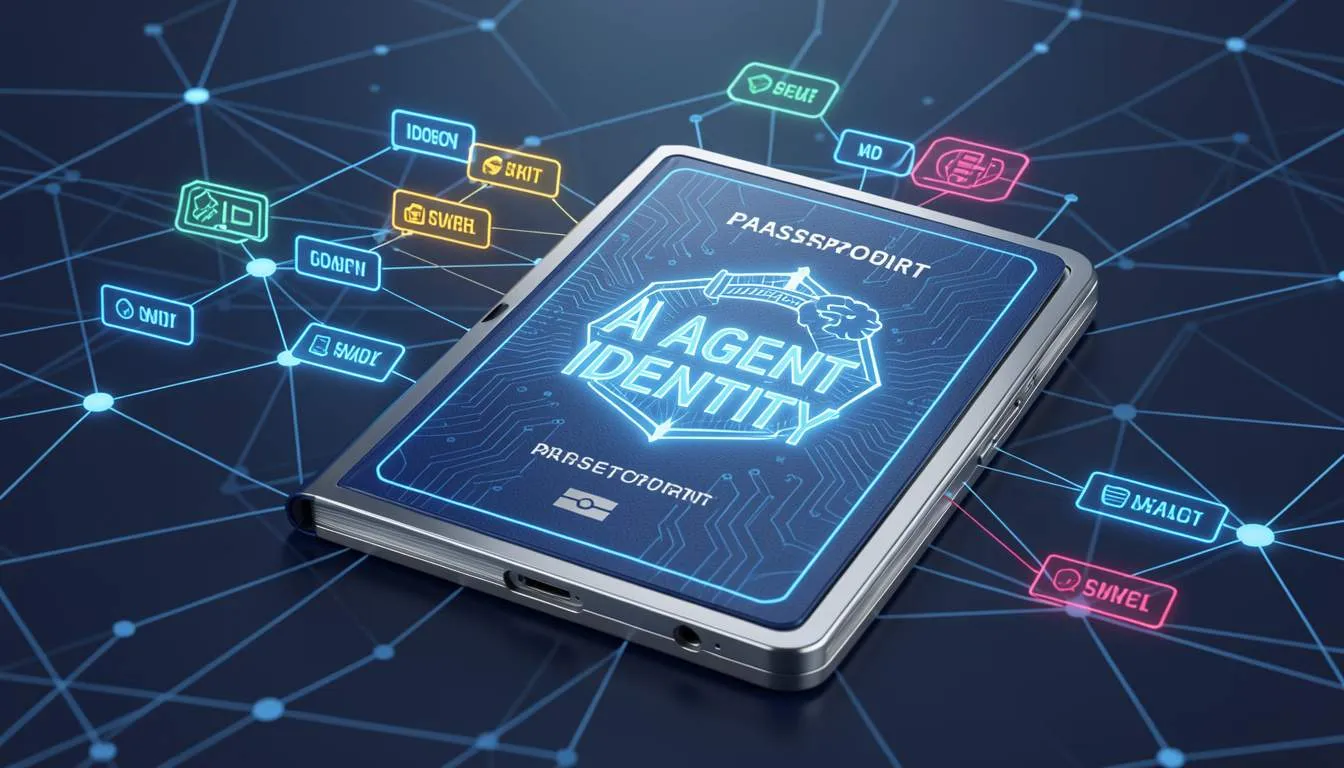
Non-Human Identities: Why Your AI Agent Needs Its Own Passport
🔑 Key Takeaways
- AI agent identity is now a core security requirement, not an architectural afterthought
- Non-human identities (NHI) must be uniquely issued, rotated, and audited
- IAM for AI should follow least-privilege and zero-trust principles
- Tracing AI actions requires per-agent credentials — no shared service accounts
- Case Study: IBM’s traceability requirement shows why unique agent credentials prevent “agent hijacking” and enable precise audits
When Your AI Agent Makes a Mistake… Who Gets Blamed?
Picture this:
A production database gets modified.
Sensitive data is accessed.
An automated workflow triggers financial transactions.
Logs show the culprit:
service-account-prod.
That’s it.
Was it a human?
A script?
An AI agent?
In 2026, this ambiguity is no longer acceptable.
As enterprises deploy autonomous AI agents into production systems, the security question is shifting from “What can the AI do?” to:
“Who is the AI, exactly?”
If your agent doesn’t have its own identity, you don’t have governance.
You have chaos.
The Core Problem: AI Agents Without Identity
Most enterprises already manage human identity well.
They use:
- Multi-factor authentication
- Role-based access control
- Privileged access management
- Centralized logging
But when it comes to AI agents?
They often:
- Share service accounts
- Use hardcoded API keys
- Run under generic credentials
- Lack per-agent traceability
This creates a serious blind spot.
Why This Is Dangerous
Without distinct AI agent identity:
- You cannot trace AI actions reliably
- You cannot apply least privilege properly
- You cannot isolate compromised agents
- You cannot prove compliance during audits
If ignored, this leads to:
- Incident response confusion
- Regulatory exposure
- Data leaks
- “Agent hijacking” scenarios
Security leaders can’t afford ambiguity at machine scale.
What Are Non-Human Identities (NHI)?
Non-human identities (NHI) refer to digital identities assigned to:
- AI agents
- Bots
- Service accounts
- Automation scripts
- APIs
In an AI-driven enterprise, NHI volume can exceed human identities by 10x or more.
This is why IAM for AI must evolve.
According to guidance emphasized by :contentReference[oaicite:0]{index=0}, traceability is non-negotiable in AI systems. Every autonomous agent must have unique credentials to ensure auditability and prevent lateral movement in case of compromise.
This isn’t theoretical.
It’s operational risk management.
Case Study: The Traceability Requirement
IBM highlights a simple but powerful rule:
Every AI agent must have unique credentials.
Why?
If multiple agents share a service account and one misbehaves:
- You cannot isolate which agent triggered the action
- You cannot confidently revoke only the compromised identity
- You cannot reconstruct the chain of execution
But when each AI agent has:
- Its own token
- Its own certificate
- Its own scoped permissions
You gain:
- Exact tracing of AI actions
- Faster forensic investigation
- Controlled blast radius
Security moves from reactive guessing to precise attribution.
How to Architect Secure Agent Identity
Let’s move from theory to implementation.
1. Issue Unique Credentials Per Agent
Every AI agent should have:
- A dedicated client ID
- Rotatable API keys or certificates
- Separate OAuth tokens
No shared service accounts.
Why it works:
You create accountability at the identity level.
2. Apply Least Privilege by Default
IAM for AI should follow zero-trust principles:
- Read-only where possible
- Scoped database access
- Granular API permissions
- No wildcard privileges
If an agent only needs billing data, it should not have access to user profiles.
3. Implement Full Trace Logging
Tracing AI actions requires:
- Correlating agent ID with system logs
- Capturing tool invocation history
- Storing execution metadata
- Timestamped decision records
When regulators or auditors ask, “What triggered this change?”
You should be able to answer in minutes — not days.
4. Enable Rapid Revocation
Assume compromise is inevitable.
Your secure agent architecture should allow:
- Instant credential revocation
- Automated key rotation
- Segmented access shutdown
This reduces breach impact significantly.
5. Integrate With Existing IAM Systems
AI agents should not live outside enterprise IAM.
They should integrate into:
- Central identity providers
- Access governance platforms
- Security information and event management (SIEM) systems
This ensures AI identity management isn’t a parallel system — but a unified extension.
Platforms like SaaSNext help organizations operationalize AI agents responsibly within production systems: 👉 https://saasnext.in/
While SaaSNext focuses on AI deployment and automation, governance is a foundational layer in sustainable adoption.
Because deploying agents without identity strategy is like issuing contractors master keys.
Common Questions (AEO Optimized)
What is AI agent identity?
AI agent identity refers to assigning unique, traceable credentials to each AI system so its actions can be authenticated, authorized, and audited.
Why are non-human identities important?
Non-human identities (NHI) ensure automation systems are governed under the same security standards as human users.
What happens if AI agents share credentials?
You lose traceability, increase breach impact, and complicate incident response.
How does IAM for AI differ from traditional IAM?
It scales dramatically. AI agents can number in thousands, requiring automated identity lifecycle management.
The Bigger Risk: Autonomous Scale Without Governance
AI agents don’t just read data.
They:
- Execute transactions
- Trigger workflows
- Modify records
- Initiate financial actions
At scale.
If each action isn’t tied to a distinct identity, you introduce systemic risk.
Enterprise architects must design secure agent architecture from day one — not as an afterthought.
Organizations building AI automation ecosystems — including those guided by SaaSNext — increasingly recognize that governance must scale with capability.
More intelligence requires more accountability.
Conclusion: No Passport, No Production
If an AI agent operates in your environment, it must have:
- A unique identity
- Scoped permissions
- Auditable logs
- Revocable credentials
No exceptions.
Non-human identities are not optional infrastructure.
They are the passport system of your AI economy.
As AI adoption accelerates, the winners won’t just deploy faster.
They’ll deploy safer.
If you’re a CISO or security architect evaluating AI expansion, start by auditing your NHI inventory today. Identify shared credentials. Map privileges. Enforce traceability.
Because the next breach won’t ask whether the attacker was human.
And neither will your regulator.