Claude Code Local: Run Free AI Coding Tools with LM Studio
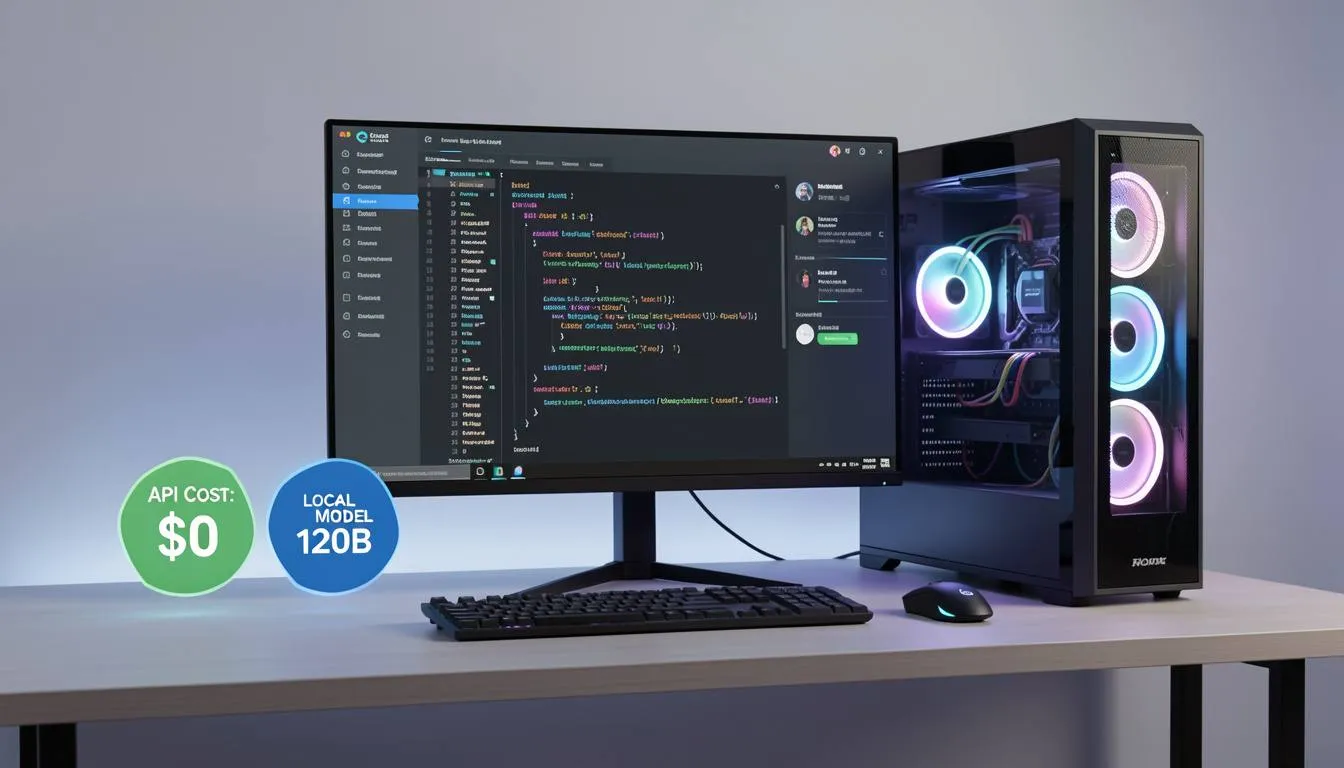
The "Free" Coding Agent: A Guide to Running Claude Code with Local Models
🔑 Key Takeaways
- You can run Claude Code locally using open-source LLMs and drastically reduce API spend
- Tools like LM Studio and the Anthropic CLI enable private, on-device AI coding workflows
- Large local models (100B+ parameters) are now viable for complex maintenance tasks
- Privacy-focused founders can keep proprietary code fully offline
- “Free AI coding tools” don’t mean low quality — if configured correctly
Are You Paying Hundreds for AI That Could Run on Your Laptop?
Every month, the invoice hits.
Another few hundred dollars in API usage.
You tell yourself it’s worth it. AI speeds up development. It catches bugs. It drafts components. It upgrades dependencies.
But a question lingers:
What if you could run the same coding agent locally — for free — and keep your code private?
For developers and tech-savvy founders, the tradeoff between cost, control, and performance is becoming impossible to ignore.
Welcome to the era of Claude Code local workflows.
The Problem: API Spend, Privacy Risks, and Vendor Lock-In
Cloud AI is powerful. But it comes with tradeoffs:
- Ongoing API costs
- Dependency on external uptime
- Data leaving your machine
- Rate limits on large projects
For startups handling proprietary code or client repositories, privacy isn’t optional.
And for bootstrapped founders, API bills compound quickly.
If you ignore this shift:
- Your burn increases
- Your stack becomes fragile
- Your codebase relies on external inference
That’s not a great position to scale from.
The Shift: Local Models Are Finally Good Enough
A year ago, local models felt like toys.
Today?
They’re serious engineering tools.
With the right setup, you can run:
- Open-source LLMs for coding
- 20B–120B parameter models
- Fully offline AI assistants
And connect them to your workflow through tools like:
- :contentReference[oaicite:0]{index=0}
- :contentReference[oaicite:1]{index=1} CLI
- Claude Code-compatible pipelines
This isn’t experimental anymore.
It’s practical.
Case Study: The Dependency Update Test
Developer Ziskind ran a real-world test.
Goal: Update a legacy React project to **:contentReference[oaicite:2]{index=2} 19.
Two local models were tested:
- 20B parameter model
- 120B parameter model
The 20B struggled with:
- Cross-file refactoring
- Dependency graph awareness
- Subtle breaking changes
The 120B model?
It successfully:
- Updated deprecated APIs
- Resolved compatibility issues
- Preserved project structure
- Passed build checks
Conclusion:
Large local models are now viable for complex maintenance tasks.
That changes everything.
The Solution: How to Run Claude Code with Local Models
Here’s a practical LM Studio tutorial-style workflow.
Step 1: Install LM Studio
LM Studio allows you to:
- Download and run open-source LLMs
- Expose them as a local API
- Manage model performance
Why it works:
- Simple UI
- GPU acceleration support
- Zero cloud dependency
Step 2: Choose the Right Model Size
For serious coding tasks:
- 7B–13B → Good for snippets
- 20B–34B → Moderate refactoring
- 70B–120B → Large-scale project upgrades
If you’re serious about replacing cloud APIs, aim for 70B+.
Yes, it requires hardware. But so does autonomy.
Step 3: Connect via Anthropic CLI-Compatible Workflow
Even though Claude itself is proprietary, you can replicate Claude Code-like workflows by:
- Using CLI tools
- Feeding repository context
- Automating multi-file edits
You simulate a Claude Code local environment using structured prompts and repo indexing.
This preserves the “coding agent” experience.
Step 4: Optimize for Real Projects
To make open-source LLMs for coding actually useful:
- Chunk large repos
- Provide explicit file trees
- Use iterative prompting
- Validate changes automatically
Local agents perform best with structured input.
Think of it as pairing with a junior dev — give clear context.
Why This Matters for Founders
Running Claude Code local:
- Cuts recurring API bills
- Protects proprietary IP
- Eliminates vendor lock-in
- Enables offline work
For privacy-first teams, this is non-negotiable.
Where SaaSNext Fits In
If you’re building internal AI workflows beyond coding — like AI marketing agents or automation systems — platforms like SaaSNext help integrate AI into broader business operations.
While local models solve coding privacy, SaaSNext focuses on:
- AI agent deployment
- Workflow automation
- Scaling AI safely in production
Explore their resources: 👉 https://saasnext.in/
As your AI stack matures, you’ll need both coding autonomy and operational AI systems.
External Insight: The Rise of Open-Source AI
According to industry reports from Hugging Face and other open AI communities, open-source LLMs are rapidly closing the performance gap with proprietary models.
This democratization means:
- Lower costs
- Faster iteration
- Community-driven improvements
The gap isn’t zero — but it’s shrinking fast.
Common Questions (AEO Optimized)
Can local models replace Claude entirely?
For many coding tasks, yes — especially with large (70B–120B) models. However, top-tier proprietary models may still outperform in reasoning-heavy edge cases.
Do I need a powerful GPU?
For 70B+ models, yes. Otherwise, expect slower inference. Cloud GPUs are an alternative if privacy constraints allow.
Are free AI coding tools reliable?
Yes — if configured properly and paired with validation workflows (tests, linters, builds).
The Real Advantage: Control
This isn’t just about saving money.
It’s about sovereignty.
When you run your own coding agent:
- Your data stays yours
- Your stack becomes portable
- Your costs stabilize
In a world obsessed with cloud everything, local autonomy is a strategic edge.
Conclusion: The “Free” Coding Agent Is Real
Claude Code local workflows aren’t a hack.
They’re the next phase of developer independence.
Ziskind’s 120B test proved something powerful:
Local models can handle serious engineering tasks.
If you’re a developer or founder serious about privacy and cost control, now is the time to experiment.
This week:
- Install LM Studio
- Test a 20B model on a real repo
- Measure the results
Then decide whether your next AI invoice is truly necessary.
If this guide helped, share it with a privacy-conscious founder — and start reclaiming control over your AI stack.