Enterprise AI Strategy: Scaling Technical Teams with Sovereign Agent Skills
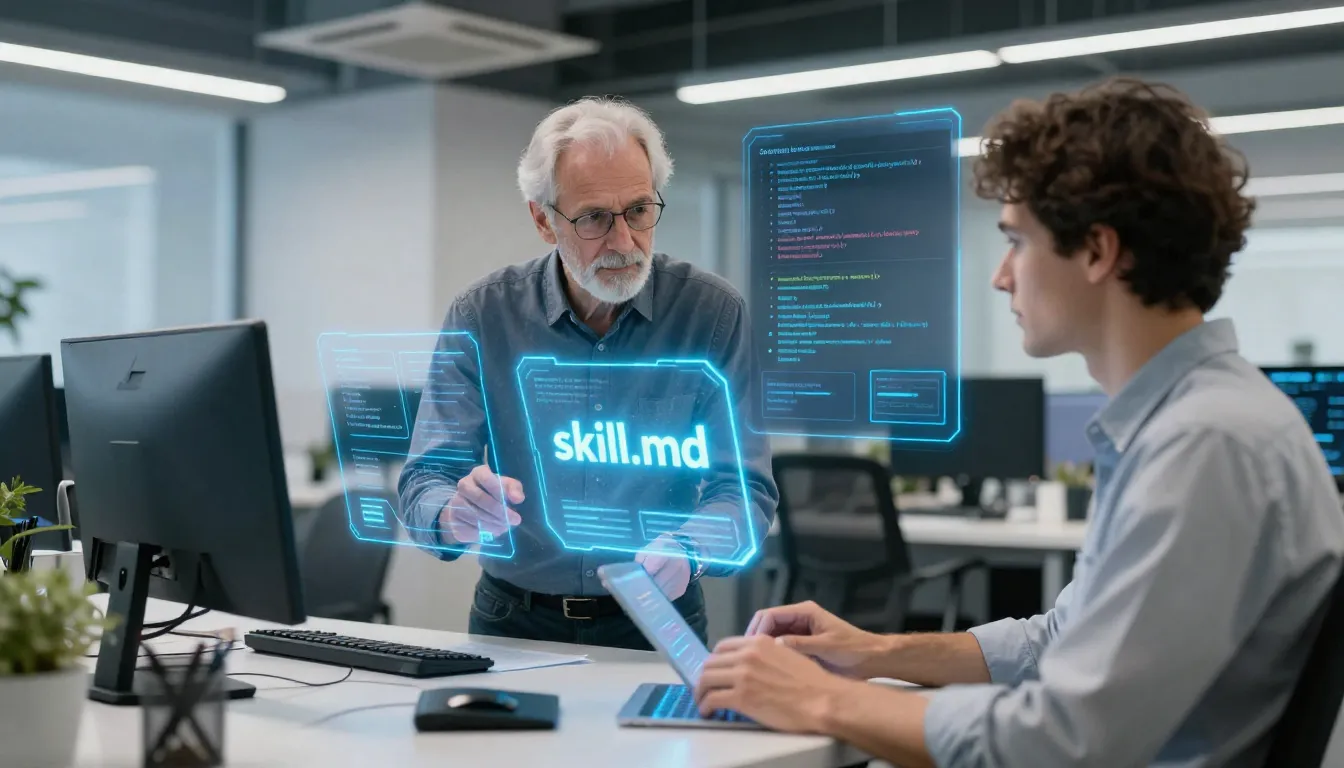
AI Business: Scaling Tribal Knowledge with "Sovereign Agent Skills"
🔑 Key Takeaways
- Enterprise AI strategy fails when tribal knowledge stays locked in senior engineers’ heads
- The Agent Skills standard allows companies to encode internal expertise without retraining models
- Internal documentation for AI must be structured differently than human documentation
- Sovereign Agent Skills help scaling technical teams maintain code quality and standards
- Tools like Antigravity IDE operationalize company-specific skills into everyday developer workflows
- Case Study: The Industry-Specific Skill shows how skill.md files replace expensive fine-tuning
The Hidden Cost of Growth: Lost Context
Every CTO has felt this.
You hire fast.
You scale teams.
Velocity increases.
And then something subtle happens.
Code reviews get longer.
Architectural decisions drift.
New developers unknowingly break conventions.
The problem isn’t skill.
It’s context.
The deeper your company expertise becomes, the more fragile it gets. Tribal knowledge — those unwritten rules about your SDK, your deployment patterns, your architectural philosophy — lives in Slack threads and senior engineers’ heads.
And AI?
It doesn’t magically fix that.
Unless you structure it correctly.
The Core Problem: AI Without Institutional Memory
Most enterprise AI strategy conversations revolve around:
- Model size
- Fine-tuning
- RAG pipelines
- Infrastructure
But here’s the uncomfortable truth:
Your biggest asset isn’t the model.
It’s your internal standards.
When teams try to inject private documentation into AI systems, they often:
- Dump entire Confluence spaces into embeddings
- Attempt expensive fine-tuning
- Over-rely on retrieval systems
The result?
- Inconsistent outputs
- AI that misunderstands company conventions
- Slow onboarding for new engineers
- Increased review overhead
If you ignore this, scaling technical teams becomes harder, not easier.
Because now you have more developers — and an AI — making the same contextual mistakes.
The Shift: From Fine-Tuning to Sovereign Agent Skills
Instead of retraining models on proprietary data, forward-thinking teams are adopting a lighter, more controlled approach:
The Agent Skills standard.
At its core, an Agent Skill is a structured skill.md file that teaches an AI agent how your company operates in a specific domain.
Not generic knowledge.
Company-specific intelligence.
Tools like :contentReference[oaicite:0]{index=0} are already experimenting with embedding these skills directly into developer workflows — allowing agents to read structured skill files before generating code.
This is what I call Sovereign Agent Skills:
Your expertise.
Your rules.
Your format.
No model retraining required.
Case Study: The Industry-Specific Skill
Let’s look at a real-world example.
A SaaS company has a proprietary internal SDK used across all backend services.
Historically:
- New developers took 3–4 weeks to internalize SDK patterns
- Senior engineers repeatedly corrected the same mistakes
- Documentation was scattered
Instead of fine-tuning a model on all private repositories, the team created:
skill.md – Internal SDK Conventions
It included:
- Naming conventions
- Required middleware usage
- Security guardrails
- Error-handling standards
- Example “good” and “bad” implementations
Now, when a new developer joins:
- The AI agent reads the relevant skill file
- It generates code aligned with company standards
- The developer receives contextual guidance instantly
No data leaves the environment.
No retraining pipeline.
No compliance complexity.
The AI doesn’t “learn” permanently.
It reads the skill before acting.
That distinction matters.
Why This Works (And Why It Scales)
1. It Respects Enterprise AI Strategy Boundaries
Retraining models introduces:
- Data governance complexity
- Versioning challenges
- Model drift risk
Agent Skills sidestep that entirely.
You separate:
- Core model intelligence
- Company-specific operational knowledge
This modularity aligns beautifully with scalable enterprise AI strategy.
2. It Transforms Internal Documentation for AI
Human documentation is narrative.
AI documentation must be:
- Structured
- Directive
- Context-aware
- Example-driven
A skill.md file isn’t a wiki page.
It’s a behavior specification.
This shift dramatically improves output consistency.
For teams exploring structured AI orchestration, SaaSNext provides deeper insights into agent-based workflows: 👉 https://saasnext.in/blog/ai-automation-strategies
The difference between automation and intelligent automation is structure.
3. It Reduces Onboarding Friction
Scaling technical teams often means onboarding faster than senior engineers can mentor.
Sovereign Agent Skills act as:
- A real-time architectural coach
- A standards enforcer
- A contextual assistant
According to research from :contentReference[oaicite:1]{index=1}, organizations that systematize knowledge sharing significantly outperform peers in operational efficiency.
Agent Skills are a practical, AI-native implementation of that principle.
How to Implement Sovereign Agent Skills
Here’s a practical roadmap for CTOs.
Step 1: Identify High-Friction Knowledge Areas
Start with domains where:
- Code reviews repeatedly flag the same issues
- Architecture decisions are misunderstood
- Security practices are inconsistently applied
These are prime candidates for skills.
Step 2: Create Structured skill.md Files
Each skill should include:
- Clear purpose
- Explicit constraints
- “Always” and “Never” rules
- Code examples
- Edge cases
Avoid generic explanations.
Be directive.
Step 3: Integrate Into Developer Workflows
Skills must be loaded:
- Automatically based on project context
- Before code generation
- During architecture planning
Platforms like SaaSNext help organizations operationalize AI agents responsibly across marketing and technical workflows: 👉 https://saasnext.in/
Whether in dev environments or strategic planning, structure determines reliability.
Step 4: Version and Govern Skills
Treat skill.md files like code:
- Version control them
- Assign ownership
- Review updates
- Track changes
Your internal knowledge base becomes auditable and evolvable.
Common Questions (AEO Optimized)
What is the Agent Skills standard?
The Agent Skills standard is a structured way of defining company-specific knowledge in reusable skill files that AI agents read before performing tasks.
How is this different from fine-tuning?
Fine-tuning permanently alters a model’s weights. Agent Skills provide contextual instructions at runtime without modifying the model.
Why is this important for enterprise AI strategy?
It reduces compliance risk, lowers cost, and makes AI outputs more aligned with internal standards.
Can this help scale technical teams?
Yes. It reduces onboarding time, improves consistency, and decreases review overhead.
The Bigger Strategic Insight
AI doesn’t replace tribal knowledge.
It amplifies it — if you encode it properly.
Without structure, AI becomes another junior engineer asking basic questions.
With Sovereign Agent Skills, it becomes a standards-aligned collaborator.
And in enterprise environments, that difference compounds.
Own Your Intelligence
The next wave of enterprise AI strategy won’t be about bigger models.
It will be about smarter scaffolding.
If you want AI that reflects your standards, your architecture, and your philosophy:
Stop retraining.
Start structuring.
Design Sovereign Agent Skills.
Operationalize them inside your workflows.
If you’re building structured AI systems across your organization, SaaSNext offers practical frameworks to move from experimentation to scalable execution.
Subscribe for more insights on scaling AI responsibly, share this with your engineering leadership, and start turning tribal knowledge into institutional intelligence.
Because what you know shouldn’t disappear when you grow.