Hyper-Personalization at Enterprise Scale: Your Customers Want You to Read Their Minds (And Now You Actually Can)
Your customer just abandoned their cart for the third time this month.
You know they want the product. They've visited the page seventeen times, read every review, compared it to competitors, and even started checkout twice before.
But you have no idea why they keep walking away at the last second.
Is it the price? The shipping cost? Trust issues? Timing? Something completely different?
Meanwhile, your competitor just sent that same customer a personalized email addressing their exact hesitation—something about expedited shipping options they were clearly concerned about—and closed the sale.
How did they know?
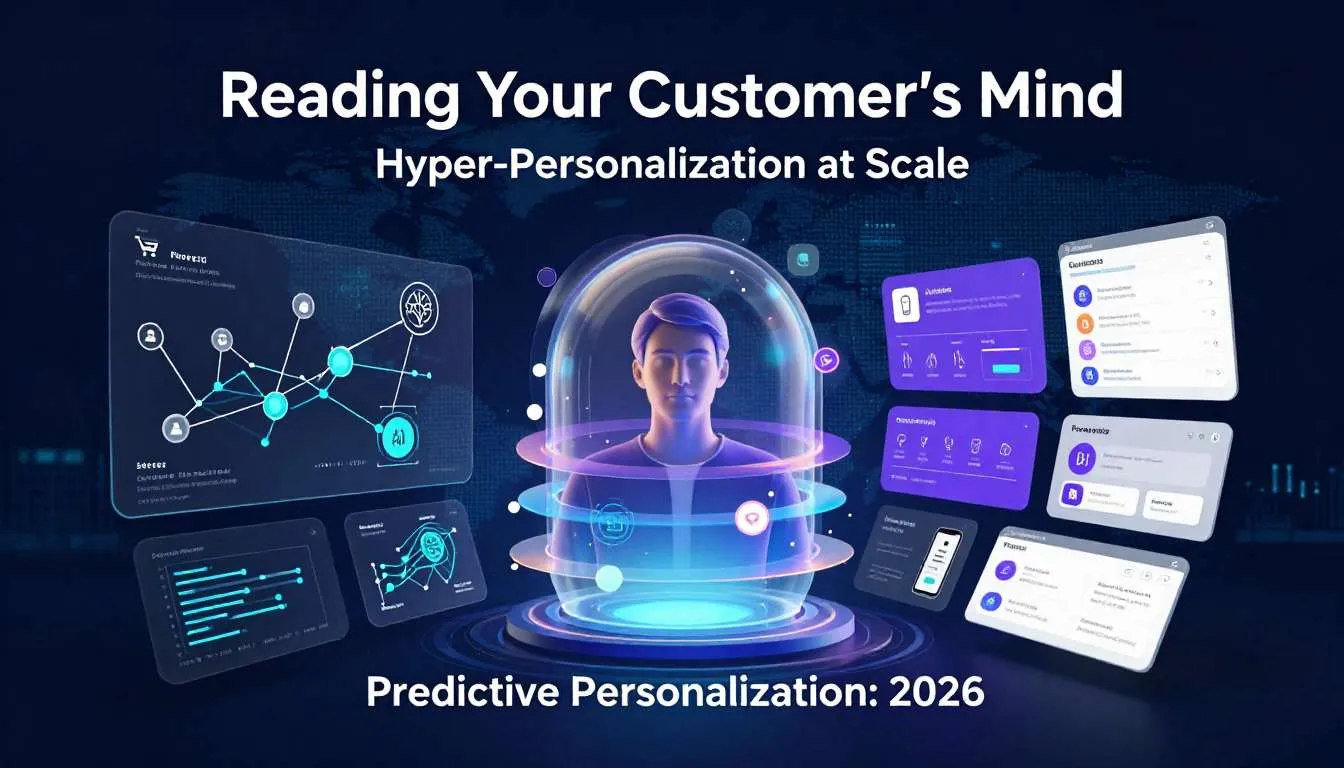
This is the gap between "personalization" as we've practiced it for the past decade and Predictive Personalization that's emerging in 2026. The difference between showing someone a product they viewed last week and understanding the emotional journey, hesitations, and decision triggers happening in real-time.
The difference between "Hi [First Name]" and actually reading your customer's mind.
Here's the uncomfortable truth: Your customers expect hyper-personalization. Not just relevant product recommendations—that's table stakes. They expect you to understand their unstated needs, predict their next move, and solve problems before they articulate them.
And if you can't deliver that experience at scale across millions of customers simultaneously? They'll find a brand that can.
The CMOs and brand managers winning in 2026 aren't just personalizing better—they're using AI Behavioral Analytics and Zero-party Data AI to create experiences so perfectly tailored that customers feel like brands are reading their minds.
Because, in a way, they are.
The Problem: The Personalization Plateau (And Why More Data Made Things Worse)
Let's talk about where enterprise personalization is actually stuck right now.
Most brands have invested millions in personalization technology over the past 5-10 years. You've got customer data platforms, marketing automation, recommendation engines, and analytics dashboards that would make a data scientist weep with joy.
And yet, your personalization efforts feel... mediocre.
The Three Failures of Traditional Personalization
Failure #1: You're Personalizing to the Past, Not the Future
Your current personalization strategy looks something like this:
- Customer viewed product X → Show them related products
- Customer purchased category Y → Email them about category Y
- Customer clicked link Z → More content like link Z
This is reactive personalization. You're responding to what customers already told you through their behavior.
The problem? By the time you act on that signal, their context has changed. They already bought that product elsewhere. Their interest shifted. Their intent evolved.
Real example: Customer browses running shoes Monday. Your email about running shoes arrives Thursday. By Thursday, they've already purchased running shoes from a competitor who sent the email Tuesday. Your perfectly personalized message is now irrelevant spam.
What's missing: Understanding why they were browsing, what's preventing purchase, and what they'll need next—before they even know they need it.
Failure #2: You're Drowning in Data but Starving for Insight
Here's the paradox: You have more customer data than ever before, yet you understand your customers less than you think.
Your data tells you:
- Customer visited website 47 times
- Viewed 23 products
- Spent average 3:42 per session
- Cart abandonment rate: 68%
- Opened 34% of emails
Your data DOESN'T tell you:
- Why they're really browsing (gift? personal use? research for work?)
- What's preventing purchase (price sensitivity? lack of trust? waiting for payday?)
- What emotional journey they're on (excited? anxious? frustrated? confused?)
- What would actually convince them to buy (social proof? guarantee? education?)
- When they're ready to make a decision (now? next week? never?)
The gap between data and understanding is where personalization efforts die.
You're optimizing for metrics (open rates, click rates, conversion rates) without understanding the human behind the data points.
Failure #3: You Can't Scale 1:1 Experiences With Current Technology
The math problem keeping CMOs up at night:
Scenario:
- 2 million active customers
- Each customer in different stage of journey
- Each customer with unique preferences, behaviors, and contexts
- Each customer requiring personalized experience across email, web, mobile, ads
Traditional approach:
- Segment customers into 20-50 groups
- Create content variations for each segment
- Apply business rules for which segment sees what
Result: Each customer gets one of 50 pre-defined experiences. That's not personalization—that's sophisticated bucketing.
True 1:1 personalization at 2 million scale? Theoretically requires 2 million unique experiences. Humanly impossible. Technically overwhelming.
Until now.
What Happens When You Stay Stuck in Traditional Personalization
For CMOs:
- Marketing spend efficiency plateaus despite increasing investment
- Customer acquisition costs rise as generic experiences lose effectiveness
- Competitive pressure from brands delivering superior personalization
- Board asking why personalization ROI isn't improving despite technology investments
For Brand Managers:
- Customer engagement rates declining
- Brand switching increasing (customers don't feel understood by your brand)
- Unable to compete with nimble competitors delivering superior experiences
- Budget cuts because "personalization isn't working"
For CRM Specialists:
- Pressure to deliver better results with existing data
- Complex technology stack that doesn't integrate well
- Manual segmentation that's time-consuming and imprecise
- Inability to prove value of personalization efforts
The market is moving toward true hyper-personalization. Staying with 2019-era approaches means getting left behind—fast.
The Solution: The Hyper-Personalization Stack That Actually Scales
Let me show you the exact framework that's enabling true personalization at enterprise scale.
The Four-Layer Predictive Personalization Architecture
Forget everything you know about traditional personalization. Here's what actually works at scale in 2026.
Layer 1: Zero-Party Data AI (The Foundation of Understanding)
What Zero-party Data actually means:
Information customers intentionally and proactively share with you, rather than data you collect through observation.
Traditional third-party data: "This person visited these websites" (going away) First-party data: "This customer clicked here, purchased this" (what you have now) Zero-party data: "This customer told us they prefer X, need Y for Z reason, and care about A, B, C"
Why this changes everything:
Zero-party Data AI doesn't just collect preferences—it uses AI to:
- Ask the right questions at the right moment
- Infer deeper needs from stated preferences
- Continuously update understanding as customer evolves
- Power predictive models with actual intent data
Practical implementation:
Instead of: "Sign up for our newsletter!" (generic, low-value exchange)
New approach: "Help us personalize your experience:
- What are you shopping for? (gift, personal, business)
- What matters most? (price, quality, speed, sustainability)
- When do you need it? (urgency level)
- What's your biggest hesitation? (actual stated concern)"
The AI layer:
Takes these direct responses and:
- Predicts unstated needs based on patterns
- Identifies similar customer journeys
- Forecasts optimal next actions
- Generates personalized experiences automatically
Real example: Luxury fashion brand Farfetch implemented zero-party data collection through a "style profile" that asks customers about occasions, preferences, and shopping motivations. Their AI uses these direct statements to predict not just products customers will like, but when they'll be ready to purchase, at what price sensitivity, and through which channel.
Result: 34% increase in conversion rate, 2.3x higher average order value, 67% reduction in returns (because AI actually understands what customers want).
Layer 2: AI Behavioral Analytics (Reading Between the Data Points)
This isn't your traditional analytics.
AI Behavioral Analytics goes beyond tracking what customers do to understanding why they're doing it and what they'll do next.
The technical approach:
Traditional analytics:
Customer viewed Product A
Customer added Product A to cart
Customer abandoned cart
Status: Cart abandoner → Send cart reminder email
AI Behavioral Analytics:
Customer behavior pattern analysis:
- Viewed Product A 7 times over 3 days (high intent)
- Compared to 4 competitors (researching thoroughly)
- Read 12 reviews (seeking validation)
- Checked return policy 3 times (risk averse)
- Abandoned at shipping page (likely shipping cost concern)
- Past purchase: Always waits for free shipping promotions

Prediction: 87% likely to purchase within 7 days if offered free shipping
Action: Personalized offer with free shipping threshold customer can reach
Timing: Send offer tomorrow (optimal based on purchase cycle)
The difference: Understanding the why behind behavior enables predicting the what next.
Key AI Behavioral Analytics capabilities:
1. Intent scoring in real-time:
- Not just "are they interested?" but "how close to purchase decision?"
- Factors: browsing intensity, comparison behavior, review reading, time investment
- Updates in real-time as behavior evolves
2. Hesitation identification:
- AI detects when customers are stuck or uncertain
- Identifies specific blockers (price, trust, timing, product fit)
- Triggers appropriate interventions automatically
3. Emotion inference:
- Analyzes interaction patterns to infer emotional state
- Detects frustration (rapid clicking, back-button usage, search failures)
- Detects excitement (rapid progression, deep engagement)
- Adjusts experience accordingly
4. Journey stage prediction:
- Where is customer in their buying journey?
- How long until they're ready to purchase?
- What needs to happen to move them forward?
Real implementation: E-commerce platform Shopify Plus implemented AI behavioral analytics that analyzes micro-behaviors (mouse movements, scroll patterns, session duration patterns) to predict purchase likelihood within next 24 hours with 84% accuracy.
The application: Merchants can automatically trigger high-intent actions (personal outreach, limited-time offers, live chat invitations) when AI predicts customer is in decision window.
Layer 3: Dynamic Creative Optimization (DCO) (Personalization That Writes Itself)
Here's where it gets really interesting.
Dynamic Creative Optimization isn't just showing different images to different segments. It's using AI to generate and test unlimited creative variations personalized to individual customer context—automatically.
How it actually works:
Old DCO:
- Creative team makes 5-10 variations of ad/email/page
- System assigns variations to segments based on rules
- Results tracked, best performers scaled
New AI-powered DCO:
- AI generates thousands of variations automatically
- Each variation personalized to individual customer context
- Real-time testing and optimization at individual level
- Continuous learning and improvement
The components:
1. AI-Generated Copy Variations:
Base message: "Save 20% on running shoes"

AI personalizes based on customer data:

Customer A (price-sensitive, budget shopper):
"Running shoes from $49 – Save an extra 20% today"

Customer B (performance-focused, premium buyer):
"Professional-grade running shoes – Limited 20% off"

Customer C (eco-conscious, values-driven):
"Sustainable running shoes – 20% off + we plant 2 trees"

Customer D (gift buyer, time-constrained):
"Perfect gift for runners – 20% off + Free gift wrap"
Each variation addresses specific customer psychographics, not just demographics.
2. Visual Optimization:
AI doesn't just swap images—it understands which visual elements resonate with which customer contexts:
- Product-focused vs. lifestyle imagery
- Color schemes matching brand affinity
- Model selection matching customer self-identification
- Layout optimizing for customer device and interaction patterns
3. Offer Personalization:
Beyond showing different products, AI optimizes the entire value proposition:
- Pricing strategy (discount depth, structure, urgency)
- Shipping options (speed vs. cost trade-offs)
- Social proof (reviews, testimonials, popularity indicators)
- Risk mitigation (guarantees, return policies, trust signals)
Real example: Netflix's DCO system generates personalized thumbnail images for each title based on your viewing history. If you watch a lot of romantic comedies, you see thumbnails emphasizing romantic elements. If you watch action films, same title shows action-focused imagery.
Result: 20-30% increase in engagement through visual personalization alone.
For enterprise marketing:
Clothing retailer Stitch Fix uses DCO to personalize every element of customer emails:
- Subject lines (testing 100+ variations per send)
- Hero images (personalized to style preferences)
- Product selection (predicted based on past keeps/returns)
- Messaging tone (formal vs. casual based on engagement patterns)
- CTA language (optimized for individual response patterns)
Impact: Email revenue per send increased 156% compared to traditional segmented approach.
Layer 4: Predictive Personalization (Acting on Intent Before It's Expressed)
This is the "mind reading" layer—using all previous layers to predict needs before customers articulate them.
How Predictive Personalization works:
Traditional: React to expressed needs Predictive: Anticipate unexpressed needs
The AI models powering this:
1. Next-best-action prediction:
- What should we offer this customer right now?
- Which channel should we use?
- What messaging will resonate?
- What's the optimal timing?
2. Life event prediction:
- Identifying major life changes from behavior patterns
- Moving, having a baby, changing jobs, major purchases
- Adjusting entire experience to new context automatically
3. Churn prediction:
- Which customers are at risk of leaving?
- What's driving their disengagement?
- What intervention will prevent churn?
- When should we act?
4. Expansion opportunity prediction:
- Which customers are ready for upsell/cross-sell?
- What specific products align with their evolving needs?
- What's the right approach for this specific customer?
Real implementation example:
Scenario: Beauty subscription service analyzing customer behavior
Predictive signals detected:
- Customer browsing maternity skincare content
- Search queries shifted to "pregnancy-safe" products
- Engagement patterns changed (timing, product categories)
- Social media activity showing pregnancy-related interests
AI prediction: Customer is pregnant (90% confidence), currently in first trimester based on product interest patterns
Automated personalization:
- Adjust entire product catalog to show pregnancy-safe options
- Email content shifts to pregnancy skincare education
- Product recommendations evolve month-by-month with pregnancy stages
- Postpartum product introductions timed to due date prediction
Customer experience: Brand "just knows" what they need, when they need it, without explicitly asking. Feels magical.
Ethical note: This requires explicit consent and transparency. Best practice: "We noticed you're browsing pregnancy content. Can we personalize your experience accordingly?" giving control to customer.
The Integration Blueprint: Making It All Work Together
Having individual components is useless if they don't integrate. Here's the architecture that works:
Data Layer (Foundation):
- Customer data platform (CDP) as single source of truth
- Real-time data streaming (behavioral signals flowing continuously)
- Zero-party data collection interfaces integrated across touchpoints
Intelligence Layer (Processing):
- AI behavioral analytics engine processing signals
- Predictive models running continuously
- Intent scoring updating in real-time
- Journey stage classification
Decision Layer (Orchestration):
- Next-best-action decisioning
- Offer optimization engine
- Channel selection logic
- Timing optimization
Execution Layer (Delivery):
- Dynamic creative generation
- Multi-channel delivery (email, web, mobile, ads)
- Real-time personalization rendering
- A/B testing and learning loops
Measurement Layer (Feedback):
- Impact tracking (incremental revenue, engagement lift)
- Model performance monitoring
- Continuous improvement loops
- ROI calculation and reporting
The tech stack (what actually works in 2026):
- CDP: Segment, mParticle, or Treasure Data
- AI Analytics: Adobe Sensei, Salesforce Einstein, or Google Cloud AI
- DCO Platform: Adobe Target, Dynamic Yield, or Optimizely
- Predictive Engine: Custom models or Klaviyo, Braze prediction capabilities
- Orchestration: Customer journey orchestration tools (Braze, Iterable, MoEngage)
Implementation reality: This isn't a 6-month project. Plan for 12-18 months for full deployment at enterprise scale.
The ROI Reality: What This Actually Delivers
Let me give you real numbers from actual implementations:
Enterprise B2C Retailer ($2B annual revenue):
Investment:
- Technology: $1.2M annually
- Implementation: $800K one-time
- Team: 4 FTEs
Results (Year 1):
- Email revenue per send: +89%
- Web conversion rate: +34%
- Average order value: +23%
- Customer lifetime value: +47%
- Marketing efficiency: +56% (less spend, better results)
Financial impact: $87M incremental revenue, 3,625% ROI
SaaS Company ($400M ARR):
Investment:
- Technology: $400K annually
- Implementation: $500K one-time
- Team: 3 FTEs
Results (Year 1):
- Trial-to-paid conversion: +41%
- Expansion revenue: +67%
- Churn reduction: 31%
- Sales cycle compression: 28% shorter
- CAC reduction: 23%
Financial impact: $24M incremental ARR, 2,667% ROI
The pattern: When implemented correctly, hyper-personalization at scale delivers 10-40x ROI in first year, compounding in subsequent years as AI models improve.
The Common Objections (And Honest Responses)
"Isn't this creepy? Won't customers feel surveilled?"
The line between helpful and creepy:
Creepy: Using data customers didn't knowingly provide, personalizing in ways that reveal you're tracking them, making assumptions without consent
Helpful: Using data customers explicitly shared, personalizing in ways that solve their problems, being transparent about how you personalize
The solution: Transparency + value exchange + control
Tell customers you're personalizing, explain the benefit, give them control. Most customers want personalization—they just want to understand and control it.
"Our data isn't good enough for this."
Real talk: Your data probably isn't as bad as you think, and zero-party data collection solves most data quality issues.
The approach:
- Start collecting zero-party data now (improves data quality immediately)
- Use AI to clean and enrich existing data
- Begin with high-data-quality segments
- Expand as data improves
Don't wait for perfect data—start building better data through implementation.
"This sounds expensive and complex."
It is. And it's worth it.
The cost of NOT doing this: Losing customers to competitors who deliver superior experiences, declining marketing efficiency, increasing customer acquisition costs.
The cost of doing this: Upfront investment that pays for itself 10-40x in first year.
Start small: Implement one layer at a time, prove value, scale investment.
"How do we prove this to the C-suite?"
The business case framework:
- Current state: Calculate cost of customer acquisition, retention rates, LTV
- Industry benchmarks: Show competitors or peers already doing this
- Pilot proposal: Small-scale test with measurable KPIs
- ROI projection: Conservative estimates based on peer data
- Risk mitigation: Phased approach, clear decision gates
Most successful approach: Run 90-day pilot with clear success metrics. If it works (it will), scale investment is easier to justify.
Your 90-Day Implementation Roadmap
Month 1: Foundation
Week 1-2: Assessment
- Audit current personalization capabilities and data quality
- Identify high-value use cases for hyper-personalization
- Evaluate technology stack gaps
Week 3-4: Planning
- Define success metrics and KPIs
- Select initial pilot use case (choose highest-value, most feasible)
- Identify required technology and resources
- Secure budget and stakeholder buy-in
Month 2: Pilot Launch
Week 5-6: Setup
- Implement zero-party data collection mechanism
- Integrate AI behavioral analytics on priority touchpoints
- Configure DCO platform for pilot use case
Week 7-8: Launch
- Begin pilot with controlled audience segment
- Monitor performance daily
- Gather learnings and optimize
Month 3: Optimization and Scaling
Week 9-10: Analysis
- Measure pilot results against KPIs
- Document learnings and best practices
- Calculate ROI and build scale-up business case
Week 11-12: Expansion Planning
- Present results to stakeholders
- Define full-scale implementation roadmap
- Secure resources for broader rollout
By day 90: You'll have proven ROI, learned implementation best practices, and built momentum for full-scale deployment.
The Future Is Already Here (Are You Ready?)
Here's the reality: hyper-personalization at enterprise scale isn't coming—it's here.
The brands delivering exceptional 1:1 experiences to millions of customers simultaneously aren't doing anything impossible. They're just using AI Behavioral Analytics, Zero-party Data AI, and Dynamic Creative Optimization to do what was impossible with human effort alone.
Your customers already expect this level of personalization. The question isn't whether to implement these capabilities—it's whether you'll do it proactively or reactively after losing market share to competitors who moved faster.
For CMOs: This is your opportunity to transform marketing from cost center to growth engine. The ROI is proven. The technology is mature. The competitive advantage is real.
For Brand Managers: This is how you build customer relationships that competitors can't replicate. Personalization at this level creates genuine brand affinity, not just transactional convenience.
For CRM Specialists: This is how you prove the value of customer data and relationship marketing. When done right, you become the most valuable team in the organization.
The gap between leaders and laggards in personalization will only widen. The brands that master Predictive Personalization in 2026 will have insurmountable advantages by 2027-2028.
Your customers want you to read their minds. The technology to do exactly that finally exists.
The only question left: Will you use it before your competitors do?