Solo-Studio Business Model: How AI Agents Are Transforming AI Video Production
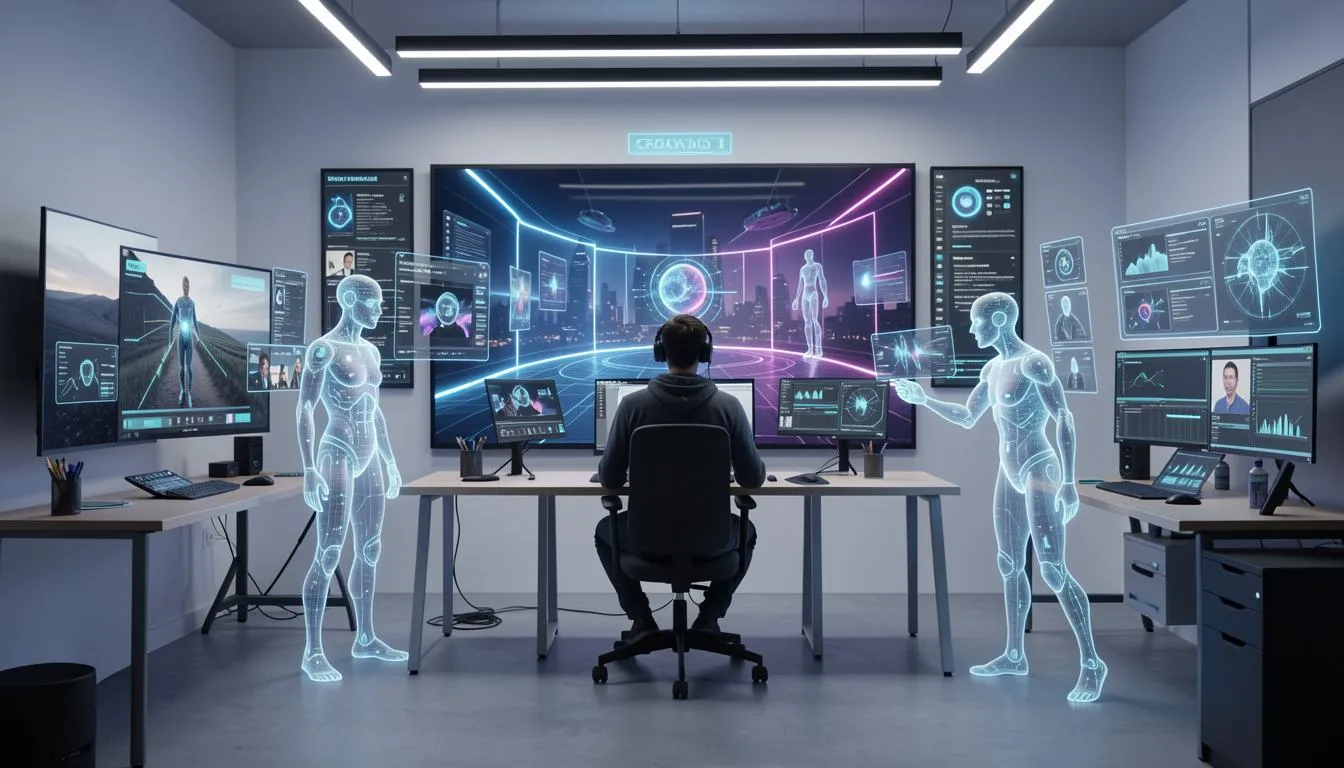
AI Business: The “Solo-Studio” — Scaling High-End Production with AI Agents
Key Takeaways
- The Solo-Studio business model enables creators and small teams to produce agency-level content using AI agents.
- Modern AI video production tools drastically reduce the cost of sets, editing, and creative research.
- Platforms like :contentReference[oaicite:0]{index=0} help creators perform rapid research and ideation before production begins.
- AI tools such as :contentReference[oaicite:1]{index=1} allow virtual environments that replace expensive physical studio sets.
- The AI-augmented creator economy is reshaping how creative agencies scale content production.
- Case Study: The Virtual Set Designer shows how creators use AI to design premium visual environments while saving thousands in production costs.
The One-Person Studio That Looks Like a 20-Person Team
What if a single creator could produce content that looks like it came from a full-scale production agency?
A few years ago, that idea sounded unrealistic. High-end content required:
- Expensive studio sets
- Professional lighting crews
- Dedicated editors
- Researchers and scriptwriters
For product teams and creators alike, quality production meant high overhead.
But AI is rewriting that rulebook.
Today, the Solo-Studio business model is emerging as a powerful new approach to creative production—where AI agents handle research, visual design, editing, and even strategic insights.
The result?
A one-person studio that delivers agency-level output at startup-level cost.
The Problem: High-End Production Is Still Painfully Expensive
Even in the age of AI tools, many companies still operate with outdated production workflows.
Product managers and marketing teams frequently face challenges like:
- Long creative cycles that delay campaigns
- Expensive physical production setups
- Limited creative experimentation due to budget constraints
- Slow research and ideation workflows
For CTOs and product leaders, this becomes a strategic problem.
When creative output is slow and expensive, it creates ripple effects:
- Campaigns launch late
- Product messaging becomes outdated
- Teams miss fast-moving market trends
Ignoring this issue means falling behind competitors who can iterate content faster and cheaper.
This is exactly where the AI-augmented creator economy begins to shift the landscape.
The Solution: Building a Solo-Studio Powered by AI Agents
The Solo-Studio model isn’t just about using AI tools randomly. It’s about designing a structured workflow where AI agents augment each stage of production.
Here’s how modern teams and creators are doing it.
1. Use AI Agents for Strategic Research
Before production begins, creators need insight.
This includes:
- Market trends
- Audience preferences
- Competitor content strategies
Platforms like :contentReference[oaicite:2]{index=2} allow creators to rapidly analyze massive amounts of information.
Instead of spending hours researching, AI agents can:
- Summarize industry insights
- Identify trending content topics
- Generate structured creative briefs
This dramatically accelerates AI product management workflows.
If you're exploring how AI agents can automate similar marketing workflows, SaaSNext explains practical frameworks here:
https://saasnext.in/blog/ai-automation-strategies
2. Replace Physical Sets with AI-Generated Environments
Studio design used to be one of the most expensive parts of video production.
Lighting rigs, furniture, background decor — all of it adds cost.
Now creators are replacing physical environments with AI-designed visual sets.
Using platforms like :contentReference[oaicite:3]{index=3}, creators can generate high-quality backgrounds and visual aesthetics that match their brand identity.
Benefits include:
- Dramatically lower production costs
- Faster content iteration
- Consistent visual branding across videos
For small teams and creators, this is a game-changer.
Case Study: The Virtual Set Designer
Creator :contentReference[oaicite:4]{index=4} explains that she “would not be a creator without AI.”
Instead of spending thousands on studio design, she uses Freepik to virtually decorate her room.
The results are remarkable:
- Higher viewer retention
- Visually striking content
- Massive cost savings on physical production
Her audience perceives a premium studio environment.
But in reality, the production is powered by AI-generated visual layers.
This is a perfect example of the Solo-Studio business model in action.
3. Automate Editing and Post-Production
Editing often becomes the biggest bottleneck in creative production.
AI tools can now automate many repetitive tasks such as:
- Cutting silence and filler words
- Color correction
- Caption generation
- Scene transitions
This allows creators to focus on creative storytelling instead of technical editing.
Product teams can use similar AI-driven workflows to accelerate video production for product launches, demos, and marketing campaigns.
4. Build AI-Augmented Creative Workflows
The real power of the Solo-Studio model comes from combining multiple AI tools into integrated workflows.
A typical AI-powered production pipeline might look like this:
- Research agent gathers insights using Manis AI
- Script agent generates story frameworks
- Design agent creates visual environments
- Production agent assists with recording and framing
- Editing agent automates post-production
This creates what many teams now call agile creative production.
Instead of slow production cycles, teams can produce high-quality content in hours rather than weeks.
Platforms like :contentReference[oaicite:5]{index=5} are helping teams adopt these AI-driven workflows by integrating AI agents into marketing and product operations.
You can explore more about how these systems work here:
https://saasnext.in/
5. Scale Creative Output Without Scaling Teams
Traditionally, scaling a creative agency required hiring:
- Editors
- Designers
- Researchers
- Production staff
But AI agents now handle many of these roles.
This allows:
- Creators to scale content production
- Agencies to increase output without growing headcount
- Product teams to launch content faster
This shift is a major driver behind the AI-augmented creator economy.
For further research on how AI is reshaping digital media production, industry analysis from :contentReference[oaicite:6]{index=6} highlights how generative AI is reducing production costs while increasing creative experimentation.
Why CTOs and Product Leaders Should Pay Attention
The Solo-Studio model isn’t just a creator trend.
It represents a broader transformation in digital production economics.
For CTOs and product leaders, this means:
- Faster content experimentation
- Lower marketing production costs
- More agile brand storytelling
Organizations that adopt AI-augmented creative workflows early will gain a significant advantage in content velocity and audience engagement.
The Future of Creative Production Is AI-Augmented
The idea of a “studio” is changing.
It’s no longer defined by cameras, lights, and sets.
It’s defined by intelligent workflows powered by AI agents.
The Solo-Studio model proves that scale is no longer about team size—it’s about systems.
And the teams that learn to orchestrate those systems will dominate the next generation of digital media.
AI isn’t replacing creativity.
It’s removing the friction around it.
When creators and product teams adopt AI-driven production pipelines, they unlock a new level of speed, experimentation, and storytelling power.
If you’re exploring how AI agents can transform your marketing or product workflows, start by studying platforms like SaaSNext, which help teams operationalize AI automation across modern digital ecosystems.
And if this topic sparked new ideas for your team, consider sharing this article with your product or marketing leadership.
Because the future of content production may not be a studio full of people.
It might just be one creator and a fleet of AI agents.