The AI Operating System: How Companies Are Building Internal AI Platforms in 2026
Your engineering team just spent three months integrating a new AI sales assistant.
It works—sort of.
But it lives in a silo.
It can’t access customer data from your CRM.
It doesn’t talk to your analytics engine.
And when Legal asked how it handles PII, no one had an answer.
Meanwhile, Marketing rolled out its own “AI content bot.”
HR launched a “candidate-matching agent.”
Finance is testing an “anomaly detection model.”
You don’t have an AI strategy.
You have AI chaos.
And you’re not alone.
According to a 2025 Gartner report, 68% of enterprises now run 5+ disconnected AI tools—with no shared governance, data layer, or security policy.
The result?
Wasted spend.
Compliance risk.
And zero compounding intelligence.
But a new approach is emerging—one that treats AI not as a feature, but as infrastructure.
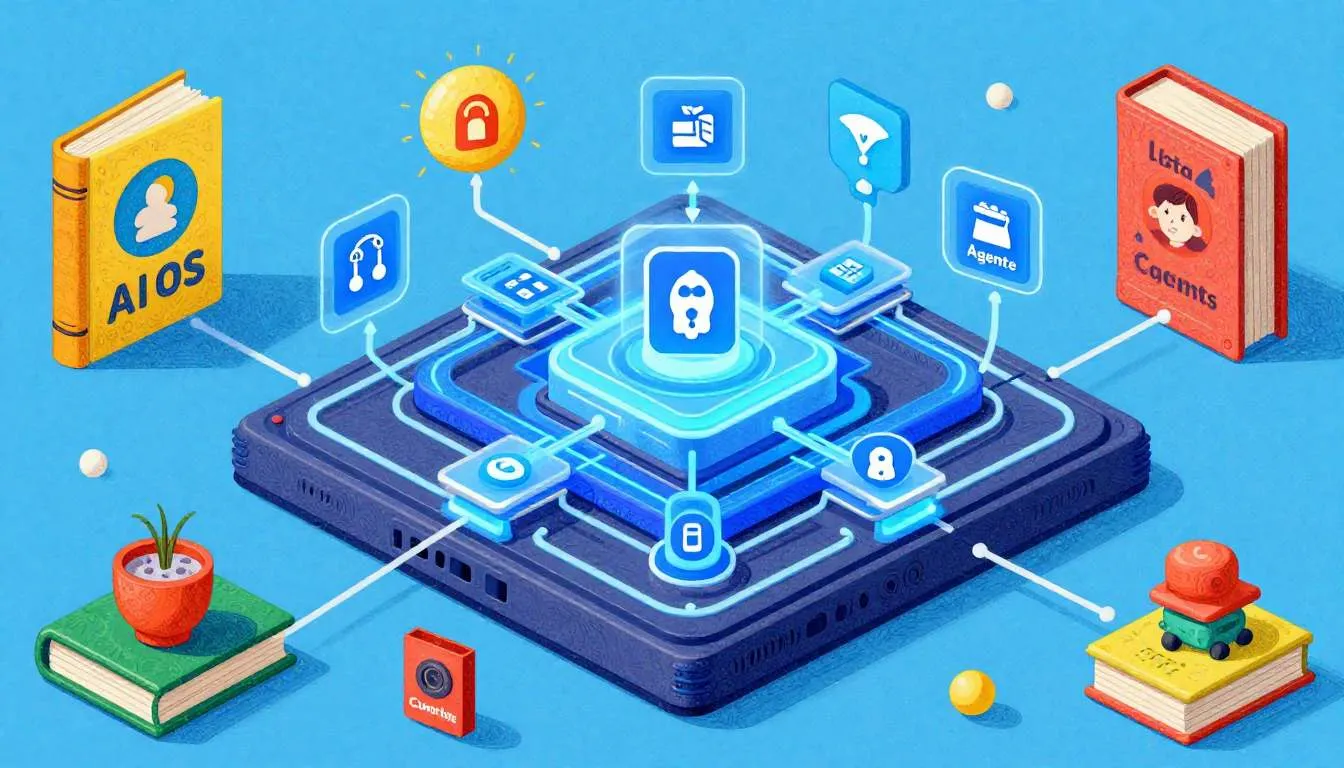
Welcome to the AI operating system: the unified, secure, and scalable backbone that lets every team in your company leverage AI—without creating chaos.
The Problem: Why Point Solutions Are Killing Your AI Strategy
Let’s be blunt: your current AI stack is a house of cards.
You’ve likely adopted tools like:
- A chatbot for customer service
- An analytics copilot for sales
- A document parser for operations
Each promises “transformation.”
But in reality, they’re islands of automation with:
- No shared identity management
- No consistent data lineage
- No unified audit trail
Worse, they encourage shadow IT.
A product manager spins up a LangChain agent on a personal AWS account.
A marketer connects a no-code AI tool to your Shopify store.
No one tells security. No one logs the data flow.
If you ignore this fragmentation, you’ll face:
- Regulatory fines (GDPR, AI Act, CPRA) for unvetted data handling
- Model drift as teams use outdated or unmonitored LLMs
- Technical debt that makes future AI integration 10x harder
You didn’t sign up to be an AI janitor.
You signed up to drive strategic advantage.
But you can’t do that when AI is a patchwork—not a platform.
The Solution: Building Your Own AI Operating System
An AI operating system isn’t a product you buy.
It’s a layer of orchestration you build—on top of your existing cloud and data infrastructure—that provides:
- Secure model access (via API gateways and RBAC)
- Unified data routing (with privacy-aware pipelines)
- Central observability (logs, costs, performance)
- Governance guardrails (prompt templates, output filters, compliance checks)
Think of it as the “Kubernetes for AI”—a control plane that lets you deploy, manage, and scale AI agents safely across the enterprise.
Here’s how leading digital transformation teams are making it real.
1. Start with a Core AI Orchestration Layer
Don’t build from scratch.
Leverage open-source frameworks to create your control plane:
- LangChain or LlamaIndex for agent routing and memory
- OpenTelemetry for tracing AI calls across services
- Open Policy Agent (OPA) for real-time permission checks
- MLflow or Weights & Biases for model versioning
Deploy this layer in your VPC—connected to your data warehouse (Snowflake, BigQuery) and identity provider (Okta, Azure AD).
Why it works: You get consistency without vendor lock-in. Every AI interaction—whether from HR or R&D—flows through the same secure, observable pipeline.
💡 Pro tip: Start with one high-impact use case (e.g., internal knowledge search). Prove the model, then expand.
2. Enforce Enterprise-Grade Security & Compliance
Your AI OS must treat data sovereignty as non-negotiable.
Implement:
- Zero-data-retention policies: Ensure prompts and outputs are never stored by third-party APIs
- PII redaction: Auto-scan inputs/outputs for sensitive info using tools like Presidio or Amazon Comprehend
- Model allowlists: Only permit approved LLMs (e.g., Azure OpenAI, Anthropic Claude, or your fine-tuned models)
This isn’t optional.
Under the EU AI Act, uncontrolled generative AI in HR or finance could be classified as “high-risk”—triggering mandatory audits.
Real example: A global bank built an AI OS that blocks any prompt containing account numbers unless the user has “compliance officer” role—reducing data leak risk by 94%.
3. Orchestrate Cross-Functional AI Agents
The true power of an internal AI platform emerges when agents collaborate.
Imagine:
- A sales agent detects a churn signal → triggers a retention agent in CRM
- A support agent can’t resolve a ticket → escalates to a product agent with engineering docs
- All interactions are logged, cost-allocated, and reviewed weekly
This is AI orchestration at scale—and it’s only possible with a unified OS.
For teams just starting out, platforms like SaaSNext offer a managed entry point. Their AI Agent Framework provides pre-built connectors for HubSpot, Zoho, and internal wikis—so you can deploy secure, branded agents without building your full OS from day one.
“SaaSNext gave us a sandbox to test agent workflows before committing to an enterprise build. It saved us 6 months of dev time.”
— CTO, Logistics SaaS
4. Measure What Matters: Cost, Quality, and Trust
An AI OS isn’t just about control—it’s about intelligence compounding.
Track:
- Token efficiency: Are agents using 10x more tokens than needed?
- Hallucination rate: How often do outputs contradict source docs?
- User trust score: Do employees rate AI responses as “helpful” or “risky”?
Use this data to continuously refine your system—replacing weak models, tightening prompts, or adding human-in-the-loop checks.
Action step: Embed feedback buttons (“Was this response accurate?”) in every AI interface. Aggregate responses in your observability dashboard.
5. Answer the Tough Questions CTOs Are Asking
Let’s cut through the noise.
Q: Do we need to build this if we use Microsoft Copilot or Google Duet AI?
A: Yes—because those are productivity tools, not platforms. They don’t connect to your proprietary data or enforce your compliance rules. Your AI OS sits alongside them, handling sensitive or custom workflows.
Q: How long does this take?
A: A minimum viable AI OS can be live in 8–12 weeks using open-source tools. Start small: secure knowledge retrieval for internal docs. Expand from there.
Q: What about cost?
A: Centralizing AI reduces waste. One manufacturer cut its LLM API spend by 41% after routing all requests through a shared caching and batching layer.
Q: Can we use this for external customers?
A: Absolutely. Your AI OS becomes the engine for customer-facing agents—e.g., a white-labeled support bot that only accesses approved knowledge bases. SaaSNext’s multi-agent system is already helping B2B brands deploy these securely.
The Bottom Line: AI Wins Go to the Orchestrators—Not the Experimenters
In 2026, competitive advantage won’t come from who has the “smartest” model.
It’ll come from who has the most coherent AI infrastructure.
The companies thriving aren’t the ones with 20 AI pilots.
They’re the ones with one AI operating system—where every agent, every query, and every insight compounds toward a smarter enterprise.
This isn’t about technology alone.
It’s about trust, control, and scale.
And it starts with a simple decision:
Stop collecting AI tools.
Start building your AI foundation.
Your Move: From Chaos to Control
You don’t need to boil the ocean.
But you do need to begin.
✅ This week: Audit all AI tools in use across departments. Map data flows and permissions.
✅ This month: Stand up a pilot AI OS for one use case (e.g., HR policy Q&A). Use LangChain + your internal docs.
✅ This quarter: Define your AI governance policy—and make your OS its enforcement engine.
The future belongs to leaders who treat AI as infrastructure, not novelty.
→ Share this with your CIO or security lead
→ Download our “Enterprise AI OS Checklist” (includes architecture diagram)
→ Explore how SaaSNext’s agent platform can accelerate your internal AI rollout
Because in 2026,
the best AI won’t be the flashiest.
It’ll be the most trusted.