The CEO Agent: How to Build Multi-Agent Systems in n8n (AI Supervisor Pattern 2026)
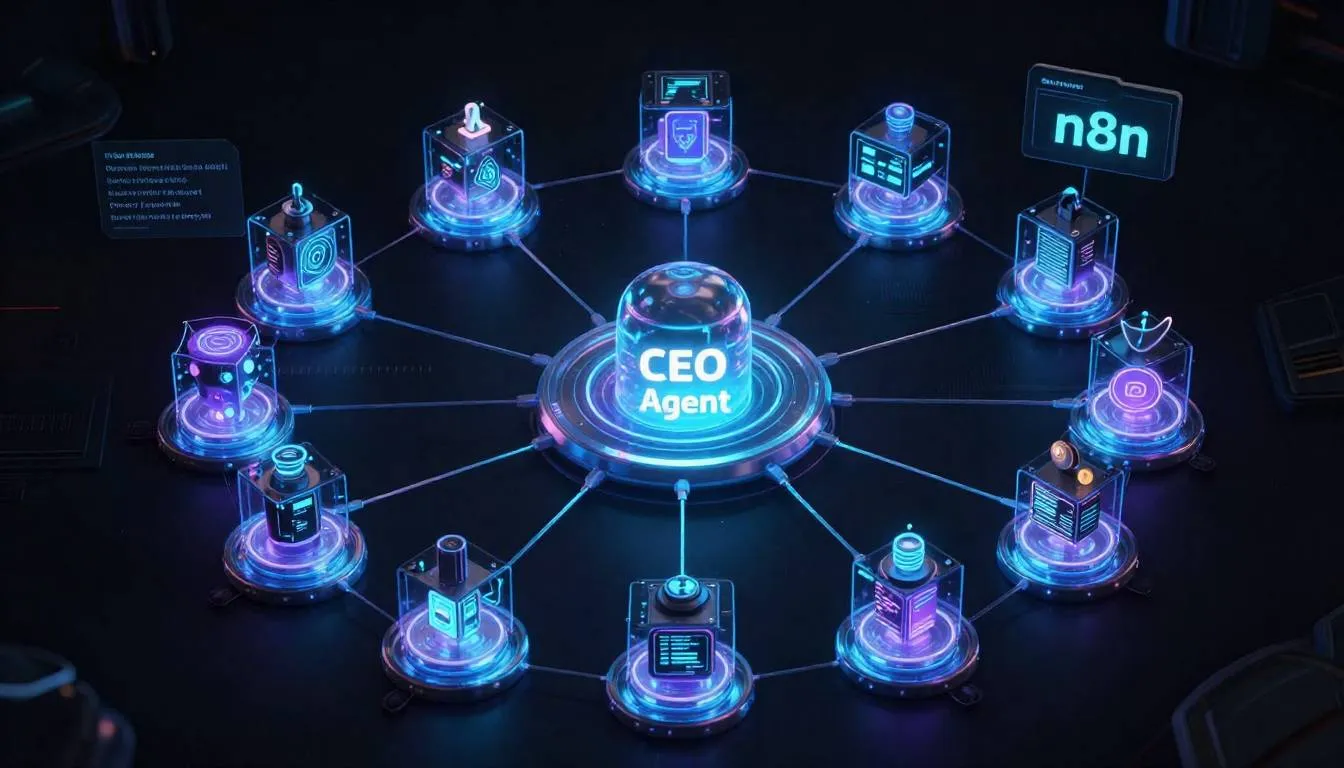
The “CEO” Agent: How to Use n8n to Orchestrate a Team of Sub-Agents (The Supervisor Pattern for 2026)
Why force one AI to do everything… badly?
In 2026, the smartest teams aren’t asking “Which AI tool should we use?”
They’re asking something far more strategic:
“How do we run AI like a company—roles, hierarchy, accountability, and specialization?”
Welcome to the age of the CEO Agent—where one supervising AI orchestrates a team of specialist sub-agents, each doing one thing extremely well.
If you’re a CEO, CMO, or growth leader drowning in half-baked AI outputs, this guide will feel like a deep exhale.
The Big Shift: From “One Smart AI” to Multi-Agent Systems
Let’s start with a hard truth.
Most teams are still using AI like it’s 2023:
- One giant prompt
- One giant output
- One giant disappointment
The result?
- Generic content
- Inconsistent tone
- Zero strategic awareness
- Endless re-prompting
AI didn’t fail you. Your structure did.
The New Mental Model for 2026
Humans don’t run companies with one employee doing everything.
Why would you run AI that way?
The future belongs to Multi-Agent Systems—where:
- One AI acts as a Supervisor (the “CEO” Agent)
- Specialized sub-agents execute clearly scoped tasks
- Each agent has its own tools, memory, and rules
This is called the AI Supervisor Pattern, and tools like n8n finally make it practical.
The Real Problem: Why Single-Prompt AI Breaks at Scale
Let’s ground this in reality.
The Everyday Marketing Pain
You create one long-form video or webinar every week.
From that, you need:
- 10 tweets for X
- 5 LinkedIn posts
- 1 polished newsletter
- Maybe even short-form scripts
What usually happens?
- One AI prompt tries to do all of it
- Tone clashes across platforms
- Content ignores platform nuance
- You spend more time fixing than creating
What Happens If You Ignore This?
If you keep using AI without structure:
- Output quality plateaus
- Brand voice fractures
- Team trust in AI erodes
- AI becomes a toy, not leverage
This is where agentic orchestration changes everything.
The Solution: The “CEO” Agent + Supervisor Pattern
Think of this as building a miniature AI company.
The Roles
-
CEO Agent (Supervisor)
- Understands the big picture
- Breaks work into tasks
- Delegates intelligently
- Reviews outputs
-
Specialist Sub-Agents
- Each optimized for a single platform or function
- Each with its own system prompt and tools
And the glue that holds it all together?
👉 The n8n AI Agent Tool Node
Why n8n Is the Backbone of Agentic Orchestration
n8n isn’t just automation—it’s logic with memory and control.
With n8n, you can:
- Chain AI agents together
- Route tasks dynamically
- Pass structured data between agents
- Trigger workflows from real business events
This is why n8n has become a favorite for building Multi-Agent Systems without writing complex code.
Case Study: The “Content Factory” Team (Real-World Example)
Let’s break down the exact system.
The Problem
A marketing agency needed to:
- Turn one long-form video into
- 10 X posts
- 5 LinkedIn posts
- 1 newsletter
- Every week
- Without burning human hours
A single AI prompt produced:
- Repetitive content
- Platform-inappropriate tone
- Low engagement
The AI Solution: A Hierarchical Agent System in n8n
They implemented a Supervisor Pattern with four agents.
1. The “Lead Editor” Agent (CEO Agent)
- Model: GPT-4o
- Role:
- Ingest the full transcript
- Identify key themes
- Break work into structured tasks
- Output:
- A task list, not finished content
This agent never writes final copy. It thinks.
2. The “X Specialist” Agent
- System prompt tuned for:
- Brevity
- Punchy hooks
- Cultural awareness
- Tools:
- Access to a Viral Trend Database
- Output:
- 10 platform-native tweets
3. The “LinkedIn Ghostwriter” Agent
- System prompt focused on:
- Authority
- Narrative flow
- Professional tone
- Output:
- 5 high-signal LinkedIn posts
4. The “Newsletter Designer” Agent
- Optimized for:
- Long-form cohesion
- CTA placement
- Scannability
- Output:
- One polished newsletter
The Result
- Dramatically higher quality outputs
- Consistent brand voice per platform
- Zero re-prompting
- AI finally felt like a team, not a tool
This is the power of Agentic Orchestration.
How to Build Your Own “CEO Agent” in n8n (Step-by-Step)
Let’s make this actionable.
Step 1: Define the Supervisor’s Job (Clearly)
Your CEO Agent should:
- Never create final content
- Only:
- Analyze
- Plan
- Delegate
- Review
This separation is crucial.
Why it works:
It mirrors human management and prevents context overload.
Step 2: Create Specialized System Prompts
Each sub-agent needs:
- A narrow mission
- Clear success criteria
- Platform-specific rules
Example:
- “You are an X strategist. Never exceed 280 characters. Optimize for engagement velocity.”
This is where Multi-Agent Systems outperform single prompts.
Step 3: Use the n8n AI Agent Tool Node
In n8n:
- Create one workflow
- Each agent becomes a node
- Pass structured JSON between agents
This allows:
- Debugging
- Version control
- Easy scaling
Step 4: Add Guardrails and Review Loops
Your CEO Agent should:
- Check outputs
- Flag inconsistencies
- Request revisions if needed
This mirrors real management—and massively improves trust.
Step 5: Connect It to Real Business Inputs
Trigger workflows from:
- New video uploads
- CRM updates
- Campaign launches
This turns AI into an operational layer, not a novelty.
Why This Matters to CEOs and CMOs (AEO-Friendly)
What is the AI Supervisor Pattern?
A system where one AI agent manages and coordinates multiple specialist agents.
Why is this better than one AI prompt?
Because specialization + coordination beats generalization every time.
Is this only for technical teams?
No. Tools like n8n make it accessible to marketing and growth teams.
Does this replace humans?
No—it removes busywork and elevates strategy.
Where SaaSNext Fits Into This Picture
Building this alone is possible—but slow.
Platforms like SaaSNext help teams:
- Deploy AI agents faster
- Design agent hierarchies
- Connect AI to real marketing workflows
- Maintain governance and control
Instead of experimenting endlessly, teams move straight to production-grade AI orchestration.
Later in scaling phases, SaaSNext becomes the control plane for managing:
- Agent performance
- Output quality
- ROI attribution
The Bigger Insight: AI Is Becoming Organizational, Not Individual
In 2023, AI helped individuals write faster.
In 2026, AI helps organizations think better.
The companies that win won’t have:
- The best prompts
- The fanciest models
They’ll have:
- The best AI structures
- Clear agent roles
- Strong supervision
Just like real companies.
Final Thought: Stop Hiring “Intern AI.” Start Building AI Teams.
If your AI feels unreliable, unfocused, or mediocre—it’s not broken.
It’s unmanaged.
The CEO Agent + Supervisor Pattern is how you turn AI from a tool into a workforce.
And n8n is how you make it real.
If this article helped reframe how you think about AI:
- Share it with your leadership or marketing team
- Subscribe for more deep dives on agentic systems
- Explore how SaaSNext can help you deploy production-ready AI agents without chaos
Because the future of AI isn’t smarter answers.
It’s better organization.