The Future of Logistics Isn’t Reactive—It’s Already Predicting Your Next Move
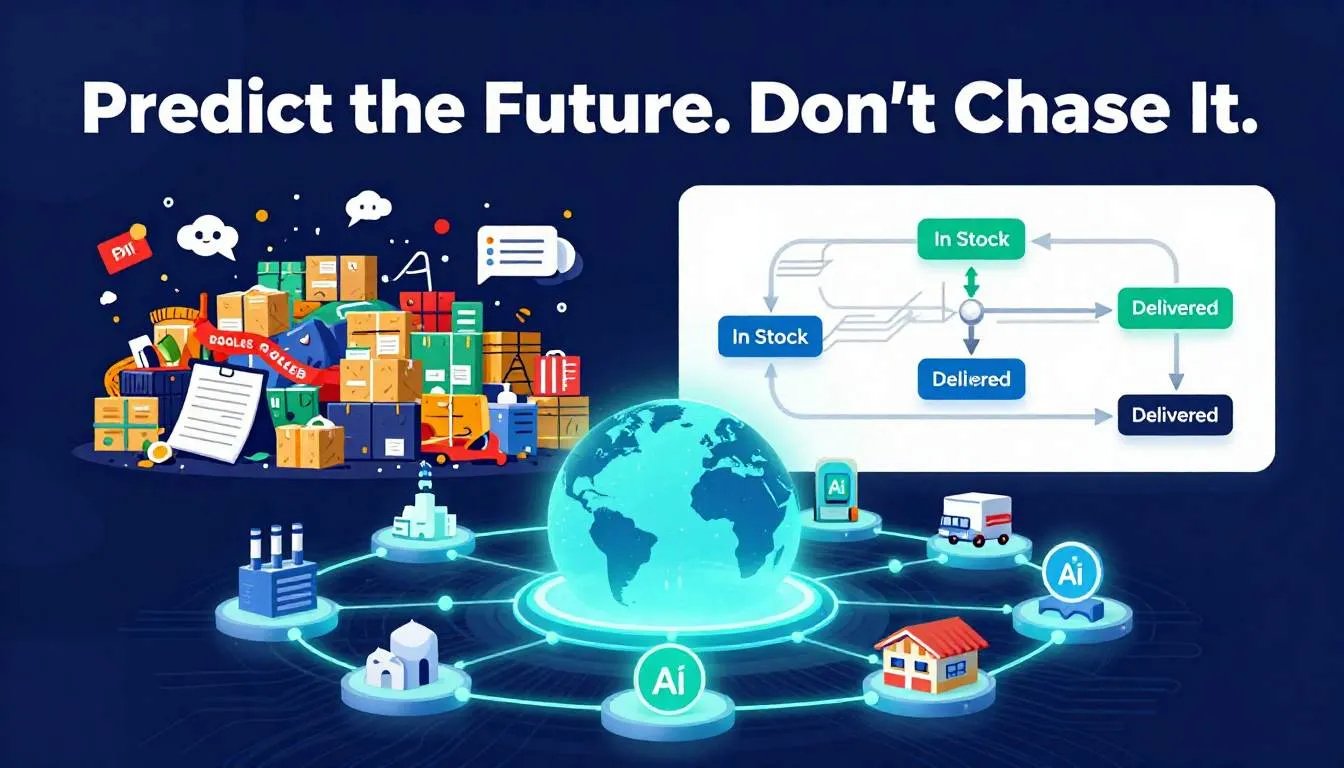
Remember that sinking feeling?
You’ve just:
- Ordered 50,000 units of a seasonal product based on last year’s sales.
- Watched social media explode with demand for a different item you barely stocked.
- Received an email from your top client: “Where’s our shipment? It was due yesterday.”
Meanwhile, your warehouse is half-full of dead stock, your freight costs are spiking, and your team is pulling all-nighters to patch holes in a system that feels more like a leaky boat than a supply chain.
You’re not failing.
You’re operating in the past.
For decades, supply chains ran on hindsight: historical data, static forecasts, and manual adjustments. But in 2026, that model is obsolete.
The new standard? Predictive logistics—where AI doesn’t just analyze what happened, but anticipates what will happen before your competitors even notice the shift.
And it’s not magic. It’s math, data, and automation working in concert to build an autonomous supply chain that’s always one step ahead.
The Problem: Why “Best Practices” Are Now Your Biggest Liability
Let’s be honest: your current forecasting process is broken.
Maybe you use:
- Excel spreadsheets updated weekly
- ERP systems that lag by 7–14 days
- “Gut feel” from regional managers who haven’t visited stores in months
The result? You’re constantly playing catch-up.
- Overstock ties up cash and warehouse space
- Stockouts erode customer trust and market share
- Expedited shipping blows your logistics budget
Worse, external shocks—viral TikTok trends, port strikes, weather disruptions—turn your “optimized” plan into fiction overnight.
If you keep relying on reactive systems, you’ll face:
- Margin erosion from markdowns and rush fees
- Lost loyalty as customers switch to brands that “just have it”
- Operational burnout as your team fights fires instead of building strategy
The cost of inaction isn’t just financial—it’s existential.
The Solution: Building a Predictive, Autonomous Supply Chain for 2026
The good news? You don’t need to rip and replace everything.
You need smart, phased integration of four key capabilities.
Here’s how forward-thinking operations leaders are doing it—right now.
1. Upgrade from Historical Forecasting to AI Demand Forecasting
Traditional forecasting assumes the future looks like the past.
AI demand forecasting knows better.
Modern systems ingest real-time signals:
- Social media sentiment
- Local weather patterns
- Competitor pricing moves
- Economic indicators
- Even foot traffic from store cameras
Then, using machine learning, they generate probabilistic forecasts—not single-point estimates—with confidence intervals.
Why it works: AI detects weak signals early. When a skincare brand noticed a 300% spike in “ceramide” mentions on Reddit, their AI model flagged a demand surge 11 days before sales data confirmed it. They rerouted inventory and captured 89% of the new demand.
How to apply it:
- Start by connecting point-of-sale (POS) data with external signals (Google Trends, local event calendars)
- Use platforms like ToolsGroup, Blue Yonder, or Oracle Fusion SCM that offer embedded AI forecasting
- Pilot on one high-volatility product line—not your entire catalog
Pro tip: Don’t aim for 100% accuracy. Aim for actionable foresight. Even 70% predictive power beats 100% hindsight.
2. Implement Smart Inventory 2026 Systems That Self-Optimize
“Smart inventory” isn’t just RFID tags and real-time tracking (though those help).
It’s inventory that thinks.
In 2026, leading retailers use digital twins of their entire inventory network. These virtual models simulate thousands of scenarios daily:
- “What if a hurricane hits Miami?”
- “What if this influencer features our product tomorrow?”
- “What’s the optimal safety stock across 12 DCs given current lead times?”
The system then auto-adjusts:
- Rebalancing stock between warehouses
- Triggering micro-fulfillment from stores
- Pausing non-essential replenishment
Why it works: It turns inventory from a cost center into a strategic asset. One fashion retailer reduced excess stock by 34% while improving in-stock rates by 22%—all through dynamic redistribution.
Action steps:
- Map your entire inventory ecosystem—including in-transit and in-store
- Integrate with your TMS (Transportation Management System) to factor in real-time freight capacity
- Set business rules (e.g., “Never let luxury items drop below 95% availability”) so the AI knows your priorities
3. Build Toward an Autonomous Supply Chain—One Layer at a Time
Full autonomy doesn’t mean “no humans.”
It means humans focus on exceptions, not execution.
An autonomous supply chain automates routine decisions:
- Purchase orders based on predictive need
- Carrier selection using real-time rate + reliability data
- Returns processing via AI-powered damage assessment
But it escalates only the truly complex issues to your team.
How to start:
- Automate one workflow first—like replenishment for fast-moving SKUs
- Use APIs to connect siloed systems (ERP, WMS, CRM) so data flows freely
- Train your team on AI oversight, not manual data entry
“Our planners used to spend 80% of their time chasing data. Now they spend 80% designing resilience.”
— Supply Chain Director, Global Electronics Brand
4. Embed Predictive Analytics Into Every Decision Layer
Predictive analytics isn’t just for forecasting—it’s for continuous optimization.
Use it to:
- Predict supplier risk (e.g., financial instability, geopolitical exposure)
- Forecast carbon footprint of shipping routes and choose greener options
- Simulate “what-if” scenarios before committing to new vendors or facilities
Real-world impact: A grocery chain used predictive analytics to identify that switching to regional co-manufacturers would cut lead times by 60% and reduce spoilage by 18%. The model even calculated the break-even point—so leadership approved it in one meeting.
Your move: Ask your analytics team (or vendor) for one predictive insight per week—not just dashboards, but recommendations. Example: “Based on weather and social trends, increase yogurt stock in Chicago by 15% next week.”
5. Answer the Tough Questions Honestly
Let’s cut through the noise.
Q: Do I need massive data to start?
A: No. Start with the data you do have—POS, shipments, inventory levels. Add external signals gradually. Even 3–4 data streams dramatically improve accuracy.
Q: Is this just for Fortune 500 companies?
A: Absolutely not. Cloud-based predictive platforms (like ClearMetal or project44) offer tiered pricing. Many mid-market retailers see ROI in under 6 months.
Q: Will this replace my team?
A: It replaces tasks, not judgment. Your team will shift from data clerks to strategic advisors—making higher-impact calls with AI as their co-pilot.
Q: What if the AI is wrong?
A: Good systems show why they made a prediction (explainable AI) and allow human override. Think of it as a highly informed colleague—not an oracle.
The Bottom Line: Predictive Logistics Isn’t Optional—It’s Survival
In 2026, customer expectations are non-negotiable:
- “It should be in stock.”
- “It should arrive tomorrow.”
- “It shouldn’t cost a fortune to deliver.”
You can’t meet those promises with a rearview mirror.
But with AI demand forecasting, smart inventory 2026 systems, and a path toward an autonomous supply chain, you’re not just keeping up—you’re setting the pace.
The companies winning today aren’t the ones with the biggest warehouses.
They’re the ones with the smartest anticipation.
Your Next Step Starts Now
You don’t need a full transformation tomorrow. But you do need to start.
✅ This week: Identify one product category plagued by stockouts or overstock. Run a pilot predictive forecast using even basic external data (e.g., Google Trends + weather).
✅ This quarter: Evaluate one predictive logistics platform that integrates with your existing ERP. Most offer free trials or sandbox demos.
✅ This year: Train your team on “AI-augmented decision-making”—not as a threat, but as a superpower.
The future of supply chain isn’t about moving boxes faster.
It’s about knowing which boxes to move, where, and when—before anyone asks.
→ Share this with your ops team
→ Download our “Predictive Logistics Readiness Checklist” (link in bio)
→ Comment below: What’s your biggest forecasting blind spot?
Because in the race to 2026, the winners won’t be the fastest movers.
They’ll be the ones who saw it coming.