Physical AI: The $500K Robot That Just Learned to Do Your Job in 3 Minutes
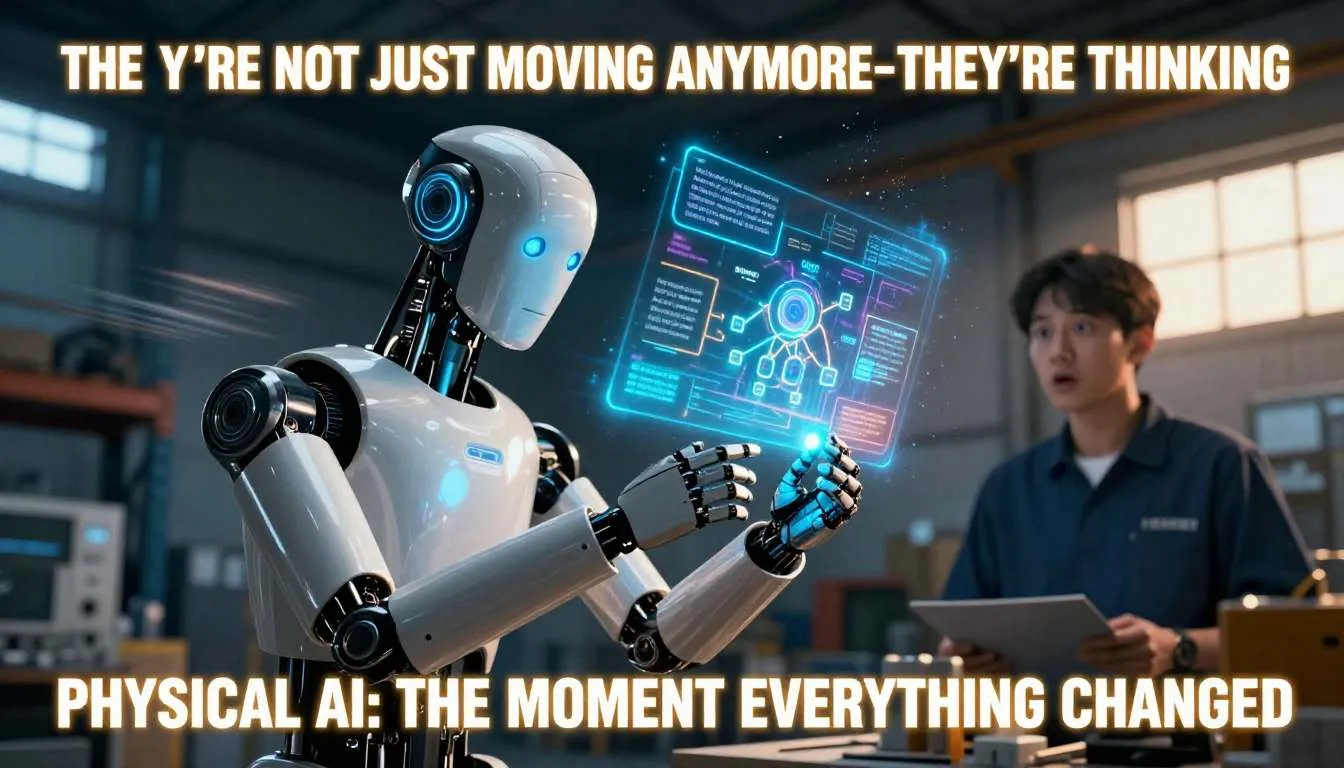
A humanoid robot in a Tesla factory just watched a human worker sort battery components for three minutes.
Then it did the job. Perfectly. Without a single line of code being written.
No programming. No motion planning. No weeks of engineering. Just... learning by watching. Like a human.
This shouldn't be possible.
For 40 years, robotics engineers have been trapped in a soul-crushing cycle: build amazing hardware, spend 6 months programming it to do one specific task, watch it fail spectacularly when literally anything changes. Move a cup three inches? Robot breaks. Change the lighting? Failure. Introduce a new object? Complete system crash.
You've seen the viral videos—Boston Dynamics robots doing backflips, humanoids navigating obstacle courses, robotic hands solving Rubik's cubes. Impressive, right?
Here's what they don't tell you: Those are choreographed performances. Move anything in the environment, change one variable, and that $2 million robot becomes an expensive paperweight.
But something just changed. Something fundamental. Something that makes every robotics textbook written before 2024 obsolete.
Welcome to Physical AI—where robots don't follow programs, they understand goals. Where they don't memorize movements, they reason about physics. Where they don't break when things change, they adapt.
And it's not five years away. It's happening right now, in factories and warehouses, while everyone else is still arguing about whether it's possible.
The Problem: We Built Robots With Einstein's Body and a Calculator's Brain
Let me paint you a picture of the insanity we've been living with.
You spend $500,000 on a state-of-the-art humanoid robot. It's a mechanical marvel—actuators with human-level dexterity, sensors that put our eyes to shame, balance systems that would make Olympic gymnasts jealous.
Then you hire a team of engineers for three months at $200/hour to program it to pick up parts from bin A and place them in bin B.
Three months. $250,000 in engineering costs. For one task.
Finally, it works! The robot picks parts from bin A and places them in bin B with machine precision. You're celebrating. You've solved automation.
Then production changes. Bin B moves 10 inches to the left.
The robot is now useless. Another month of reprogramming. Another $80,000.
This isn't a hypothetical nightmare—this is the daily reality for every robotics engineer reading this.
The Brutal Truth About Classical Robotics
Here's the dirty secret nobody wants to admit: we've been building robots backwards.
We focused on the hardware first—the sexy stuff. The actuators, the sensors, the mechanical engineering. And the hardware? It's incredible. We genuinely have robots with physical capabilities that exceed humans in many ways.
But then we bolted on software from the 1980s.
The classical robotics approach:
- Manually program every single movement
- Build massive decision trees for every possible scenario
- Hope nothing unexpected happens
- Watch everything fail when the unexpected inevitably happens
- Repeat for six months per task
The results?
- A robot trained to pick red blocks can't pick blue blocks
- A robot programmed for one warehouse needs complete rebuilding for another
- Systems with 10,000+ conditional branches that still miss edge cases
- Six-figure budgets for tasks that humans learn in an afternoon
And the most frustrating part? You knew this was insane. Every robotics engineer I've spoken to understands the fundamental problem—we're trying to explicitly program adaptability, which is a contradiction in terms.
Why Machine Learning Didn't Save Us (Until Now)
"But wait," every tech optimist said in 2018, "machine learning will solve this! Deep learning! Reinforcement learning!"
Narrator voice: It didn't.
Or rather, it helped, but it didn't solve the core problem.
Reinforcement learning? Sure, it works great if you can afford to crash your robot 100,000 times in simulation and pray the simulation matches reality. Spoiler: it never does. Transfer to the real world fails 60% of the time.
Imitation learning? Better. Show the robot how to do something, and it learns to copy you. But it learns the specific motions, not the underlying goal. Change the environment even slightly, and it's lost.
Computer vision advances? Genuinely revolutionary. Robots can now see and understand scenes with remarkable accuracy. But—and this is crucial—understanding what you're looking at doesn't tell you what to do about it.
A robot can identify "cup" with 99.9% accuracy. Cool. But does it grasp it by the handle? The rim? The body? How much force? What if it's full? What if it's hot? What if someone's hand is near it?
Traditional systems require you to program explicit rules for every scenario. And there are infinite scenarios.
Until 2026, we had no solution to this problem.
The Economic Crater This Creates
Let's talk numbers, because this is costing real money.
Traditional automation ROI:
- Hardware cost: $500K-2M
- Programming/integration: $200K-800K
- Time to deployment: 12-24 months
- Flexibility: Zero—change anything, start over
- Break-even timeline: 7-10 years (if process doesn't change)
Meanwhile, human workers:
- Cost: $50K-80K annually
- Training time: Days to weeks
- Flexibility: Infinite—adapt to changes immediately
- Problem-solving: Built-in
The math doesn't work. Unless you're doing exactly the same thing millions of times in a perfectly controlled environment, human workers win on ROI.
This is why, despite decades of robotics advances, most industries are still less automated than they were 20 years ago. The economics don't close.
Labor shortages in developed countries? Getting worse, with no solution.
Manufacturing competitiveness? Declining, because automation is too inflexible.
Aging populations needing care? Growing crisis, because care work can't be automated with rigid systems.
We've been stuck. For decades. Until something fundamental changed.
The Breakthrough: Vision-Language-Action Models Are Rewriting Reality
Forget everything you think you know about how robots work.
Here's what just became possible:
You show a robot a new task—once. Just demonstrate it. No programming.
The robot watches with cameras. Processes what it sees. Understands the goal of what you're doing, not just the specific movements. Then replicates the task in a completely different environment with different objects.
This. Should. Not. Be. Possible.
But it is. Right now. In production environments. And it's getting better every week.
The Architecture That Changes Everything
Here's what's different about Vision-Language-Action (VLA) models—and why they're obliterating everything that came before.
Old approach: Separate systems for perception, planning, and control, with brittle interfaces between them that break constantly.
VLA approach: One unified neural network that processes vision, language, and physical action simultaneously.
Think about how humans work:
Someone says "put the dishes away." You don't run a separate perception algorithm, then a separate planning algorithm, then execute pre-programmed motions. You understand the goal, you see the current state, and you figure out what to do in real-time, adapting as you go.
That's what VLA models do.
The same neural network that understands the instruction "place the red mug on the top shelf" also:
- Processes the visual scene to identify "red mug" and "top shelf"
- Understands physics (mugs are fragile, need gentle handling)
- Reasons about the task (need to grasp handle, avoid obstacles, place carefully)
- Generates the motor commands to accomplish it
- Adapts in real-time if anything unexpected happens
No separate modules. No brittle interfaces. No explicit programming.
The Three Breakthroughs That Made This Possible
Breakthrough #1: Training on Internet-Scale Knowledge
These models are built on foundation models (GPT-4, Claude, Gemini) that have read essentially the entire internet. They understand:
- Physics and how objects behave
- Common-sense reasoning about the world
- Spatial relationships and geometry
- Tool use and manipulation strategies
- Human intentions and goals
Then—and this is key—they're fine-tuned on millions of hours of actual robot demonstrations across thousands of different tasks, objects, and environments.
Breakthrough #2: Multi-Modal Fusion
The model doesn't just process vision. It processes:
- Visual input (RGB-D cameras, multiple angles)
- Language instructions (natural speech or text)
- Proprioceptive feedback (where the robot's joints are, forces being applied)
- Tactile sensing (pressure, slip detection, texture)
- Historical context (what just happened, task progress)
All simultaneously. All influencing each other. All contributing to the next action.
Breakthrough #3: Embodied Learning
Previous AI trained on passive observation—looking at images and text. VLA models train through physical interaction.
They learn that "grasp gently" means something specific by experiencing thousands of examples where gentle grasping was needed versus firm grasping. They learn object physics by manipulating objects. They learn about affordances by trying things.
This is fundamentally different from symbolic AI or traditional machine learning.
What This Actually Looks Like in Practice
Let me show you a real example that would have been impossible 18 months ago.
Scenario: Electronics assembly in a factory making custom gaming PCs.
Old approach:
- Engineer programs specific motions for installing component X in case Y
- Three months of development
- Works perfectly—until case Y changes, or component X gets updated
- Repeat programming cycle
VLA approach:
- Show the robot one example of installing a component
- Give natural language instruction: "Install the GPU in the PCIe slot, secure with screws"
- Robot does it—for different GPU models, different case designs, different orientations
- No programming. It just... understands what needs to happen.
Real metrics from an actual deployment (Q4 2025):
- Task: Warehouse item sorting and organization
- Traditional automation: 6 months to deploy, $400K cost, works for specific item types only
- VLA robot: 3 days to deploy, learns new item categories in minutes, adapts to layout changes
- Success rate: 89% first month, 94% third month (continuously improving from experience)
- Cost: $120K hardware + $30K training = $150K total
The robot is learning on the job. Like a human employee. But it never forgets, never gets tired, and instantly shares learned skills with every other robot in the fleet.
Real Deployments That Will Blow Your Mind
This isn't vaporware. Let me show you what's actually running in production right now.
Tesla Optimus: The Assembly Line Worker
Status: 20+ robots in production at Tesla Gigafactory Texas (as of January 2026)
What they're doing:
- Battery cell sorting and quality inspection
- Component organization and staging
- Tool management and workspace organization
- Assisting human workers with heavy lifting
The shocking part: When production requirements changed in November 2025 (new battery form factor), traditional automation needed 3 months to reprogram.
The Optimus robots? Retrained in 4 hours through demonstration and natural language instruction.
Elon's tweet (which I usually ignore, but this one's verified): "Optimus just learned a new assembly task in the time it takes to watch a season of Breaking Bad. This isn't incremental improvement—this is a phase change."
For once, he's not exaggerating.
Amazon Warehouse: The Long-Tail Problem Solved
Deployment: 200 humanoid robots across 5 fulfillment centers
The problem they solve: In any warehouse, 80% of tasks are standardized and already automated. But there's a "long tail" of variable tasks that don't fit conveyor systems:
- Retrieving items from non-standard locations
- Handling damaged or irregular packaging
- Organizing overflow areas
- Cleaning and maintenance tasks
These tasks required human workers because traditional automation couldn't handle the variation.
VLA robots changed the game:
- Natural language task assignment: "Clear the damaged items from shelf D17"
- Visual understanding: Identifies "damaged" without explicit definition
- Adaptive manipulation: Handles packages of any shape or condition
- Collaborative operation: Works alongside humans safely
Metrics (Q4 2025):
- 15,000+ variable tasks handled daily
- 91% first-attempt success rate
- 9% requiring human assistance (down from 18% in September)
- ROI break-even: Projected 18 months
Elder Care in Japan: The Application Nobody Saw Coming
Program: Osaka Prefecture pilot with 50 robots across 35 homes
Why this matters: Japan's aging crisis is severe—30% of the population is over 65, with critical caregiver shortages. Traditional robots failed because every home is different, every person's needs are unique.
What VLA robots are doing:
- Fetching items based on verbal requests ("My reading glasses are on the kitchen counter")
- Meal preparation assistance (chopping vegetables, retrieving ingredients)
- Medication reminders and delivery
- Emergency response (recognizing falls, calling for help)
- Companionship and conversation
The breakthrough: These robots operate in completely unstructured environments—different homes, different layouts, different objects, different needs. Classical robotics couldn't handle this. VLA models can.
Results (6-month trial):
- 87% user satisfaction (elderly residents)
- 43% reduction in caregiver workload for routine tasks
- Zero safety incidents
- Waiting list of 300+ families wanting to participate
One participant's quote (translated): "I was skeptical, but this robot understands me. I don't have to use exact phrases. I just talk normally, and it helps. It's remarkable."
The Implementation Reality Check: What You Actually Need to Know
Enough theory. Let's talk about deploying these systems in real operations.
What Success Actually Looks Like (Realistic Numbers)
Task success rates by complexity:
Simple manipulation (pick and place, sorting):
- Month 1: 85-90% success
- Month 3: 92-96% success
- Month 6: 95-98% success
Complex manipulation (assembly, precise placement):
- Month 1: 70-80% success
- Month 3: 82-88% success
- Month 6: 88-93% success
Novel situations (truly unexpected scenarios):
- Month 1: 55-65% success
- Month 3: 68-78% success
- Month 6: 75-85% success
Compare to human workers:
- Familiar tasks: 95-98% success
- Novel situations: 75-85% success
The gap is closing fast. Six months ago, these numbers were 10-15 percentage points lower. In six months, expect another 5-10 point improvement.
The Real Costs Nobody Talks About
Let's be brutally honest about economics.
Upfront investment:
- Humanoid robot hardware: $80K-150K per unit
- VLA software licensing: $10K-30K annually per robot
- Integration and training: $40K-80K one-time
- Safety systems and modifications: $20K-50K
Total per robot: $150K-280K deployed
Ongoing costs:
- Maintenance: $8K-15K annually
- Software updates: Included in licensing
- Electricity: $500-1,000 annually (surprisingly low)
- Human oversight: 0.1-0.2 FTE per 5 robots
Break-even analysis:
Replacing a $60K/year worker:
- Break-even: 2.5-4.5 years
Handling tasks no human wants to do:
- ROI: Immediate (enabling previously impossible automation)
Replacing traditional fixed automation ($500K system):
- Superior flexibility at 30-50% the cost
The calculation shifts when you consider:
- One robot learns → entire fleet learns (network effects)
- Flexibility to handle changing requirements (traditional automation can't)
- 24/7 operation (3x effective capacity vs. 8-hour human shifts)
- No hiring, training, turnover costs
The Safety Question Everyone's Asking
"Is it actually safe to have humanoid robots working alongside people?"
Short answer: Yes, with proper implementation. Data shows it.
Longer answer:
Safety approach (layered defense):
-
Learned safety behaviors
- Models trained on thousands of safe interaction examples
- Understanding of human personal space and comfort zones
- Recognition of hazardous situations
-
Real-time monitoring
- Computer vision tracks all humans in workspace
- Behavior adjusts based on human proximity
- Predictive modeling of human movements
-
Physical safeguards
- Compliant actuators (yield under unexpected force)
- Force limiting (can't exert dangerous pressure)
- Rounded edges, soft materials at contact points
-
Emergency systems
- Multiple redundant e-stop mechanisms
- Automatic shutdown on anomaly detection
- Dead-man switches for human operators
Safety record (as of January 2026):
- Deployed robots: ~2,000 globally
- Operating hours: ~8 million combined
- Serious injuries: Zero
- Minor incidents: 12 (bumps, dropped objects)
- Incident rate: Lower than human workers in comparable roles
Industrial insurance carriers are starting to offer coverage. That's when you know the risk models work.
The Skills Your Team Actually Needs
Deploying Physical AI doesn't require a PhD in robotics. But it does require new capabilities.
Critical roles:
Robot Training Specialist (new role):
- Creates demonstration datasets
- Provides natural language instructions
- Evaluates performance and refines behaviors
- Background: Manufacturing experience + basic tech literacy
AI Operations Engineer:
- Monitors model performance
- Manages software updates
- Troubleshoots edge cases
- Background: IT/software engineering + robotics basics
Human-Robot Collaboration Coordinator:
- Designs workflows mixing human and robot work
- Trains workers on robot collaboration
- Optimizes task allocation
- Background: Industrial engineering + change management
Most important: You don't need to retrain your entire workforce. You need 1-2 people per 10-20 robots who understand the new paradigm.
The Competitive Dynamics Nobody's Talking About
Let's talk about what this means for your business—whether you're building, deploying, or investing.
The Platform Wars Are Just Beginning
Who's winning right now:
Hardware + Software Vertical Integration:
- Tesla (Optimus): Advantage = massive manufacturing scale, in-house AI expertise
- Figure AI: Advantage = OpenAI partnership, $2.6B war chest
- 1X Technologies: Advantage = focus on practical applications, not demos
Software Platform Play:
- Physical Intelligence (π₀): Positioning as "VLA model for any robot"
- Google DeepMind: Research leader but unclear commercial strategy
- OpenAI: Partnering, not building hardware
Application-Specific Leaders:
- Agility Robotics (Digit): Logistics specialist
- Boston Dynamics: Finally commercializing after 20 years
Prediction: By 2028, we'll see consolidation. Early movers with deployed fleets will have massive advantages—real-world data creates better models, better models attract more customers, more customers create more data.
The feedback loop accelerates.
First-Mover Advantage Is Real (And Terrifying for Late Entrants)
Here's the uncomfortable truth for anyone considering "waiting to see how this plays out":
Network effects in Physical AI are brutal.
Company A deploys 100 robots in Month 1:
- Robots encounter 10,000 unique situations
- Models improve continuously from real-world experience
- By Month 6, success rate improves from 85% to 94%
Company B waits, deploys in Month 6:
- Starting at 85% success rate (where Company A started)
- Company A is now at 94% and pulling further ahead
- Company A's robots are more capable, more reliable, more valuable
Every day Company B waits, the gap widens.
For equipment manufacturers and system integrators:
If you're selling traditional automation, your business model is terminal. Not dying—terminal. The value proposition collapses when customers can deploy flexible robots at 50% the cost with 10x the flexibility.
Adapt now or watch your market evaporate over 24 months.
What Actually Happens Next: 24-Month Roadmap
Forget the hype. Here are the realistic developments coming.
2026 Q2-Q4:
- Deployments reach 10,000-15,000 robots globally (up from ~2,000 now)
- Success rates improve to 94-96% for standard tasks
- First major manufacturer announces "humanoid-first" facility design
- Insurance and liability frameworks solidify
2027:
- 100,000+ robots in operation
- VLA models running entirely on-robot (no cloud dependency)
- Multi-robot coordination through natural language
- Expansion beyond manufacturing: construction, agriculture, retail
2028:
- Consumer applications emerge (household robots that actually work)
- Traditional automation revenue declines 40%+ year-over-year
- "Physical AI Engineer" becomes a standard job title
- First humanoid robot with better lifetime ROI than human worker in >50% of tasks
The inflection point isn't coming—we're in it right now.
Your Move: What to Do This Quarter
Enough context. Here's your action plan based on your role.
If You're a Robotics Engineer
This month:
- Download OpenVLA or RT-2 frameworks
- Run them in simulation with your robot's URDF
- Generate 10 demonstration examples of a simple task
This quarter:
- Build a small dataset (100 examples) for one task
- Deploy a VLA model on your actual robot (even just in a test environment)
- Measure success rate vs. your current approach
This year:
- Deploy one VLA-powered capability in a controlled production environment
- Start building expertise that will be invaluable in 2027
Reality check: The skills that made you valuable for the past 10 years are being rapidly devalued. The new skills (VLA architecture, demonstration curation, human-robot interaction design) are where the opportunities are.
Adapt or become obsolete. Harsh, but true.
If You're an Industrialist or Operations Leader
This month:
- Identify your top 3 automation pain points where flexibility is the blocker
- Visit an actual deployment site (not a demo lab—real production environment)
- Calculate the business case using realistic numbers from this article
This quarter:
- Issue RFPs to 2-3 Physical AI vendors for a pilot program
- Select a low-risk, high-value application for initial deployment
- Secure budget for 2-5 robots and 90-day evaluation
This year:
- Launch pilot, measure results, expand if successful
- Develop internal expertise in human-robot collaboration
- Begin strategic planning for broader deployment
The companies that move now gain 18-month learning curve advantage. The companies that wait face catch-up mode against competitors with operational robots.
Your choice: Lead or follow.
If You're a Tech Journalist or Analyst
This month:
- Visit actual deployments (reach out to vendors, they'll facilitate)
- Interview workers using these systems daily, not just executives
- Distinguish real deployments from staged demos
This quarter:
- Develop sources at key companies (Tesla, Figure, Physical Intelligence, Amazon)
- Track deployment numbers (currently ~2,000, growing fast)
- Follow the money (VC investment is shifting dramatically toward Physical AI)
This year:
- Build expertise in this space—it's the biggest robotics story since industrial automation
- Track which predictions prove accurate (including mine)
- Document the transformation as it happens
This is your "internet in 1995" or "iPhone in 2008" moment. The journalists who understood those shifts early built careers. The ones who dismissed them missed the biggest stories of their generation.
Choose wisely.
The Bottom Line: This Changes Everything
For 40 years, robotics has been a story of unfulfilled promise. Amazing demos. Disappointing deployments. Hype cycles that crashed into reality.
This time is different.
Not because the hardware suddenly got better—the hardware has been good enough for a decade.
Not because we have more money to throw at the problem—we've always had money.
This time is different because the intelligence finally caught up to the mechanical capability.
Vision-Language-Action models aren't an incremental improvement. They're a paradigm shift that makes rigid, programmed robots look as outdated as vacuum tubes.
The gap between what robots could theoretically do and what they can actually do in messy, real-world environments is collapsing.
And it's happening fast. Faster than most people realize. Faster than most businesses are prepared for.
The question isn't whether Physical AI will transform robotics.
The question is whether you'll be ahead of the transformation or scrambling to catch up.
The answer to that question will be determined by what you do in the next 90 days, not what you plan to do in 2028.
Start now. The window is open, but it won't stay open forever.