Physical AI: The Robot-LLM Merger That's Finally Making Humanoid Robotics Actually Useful
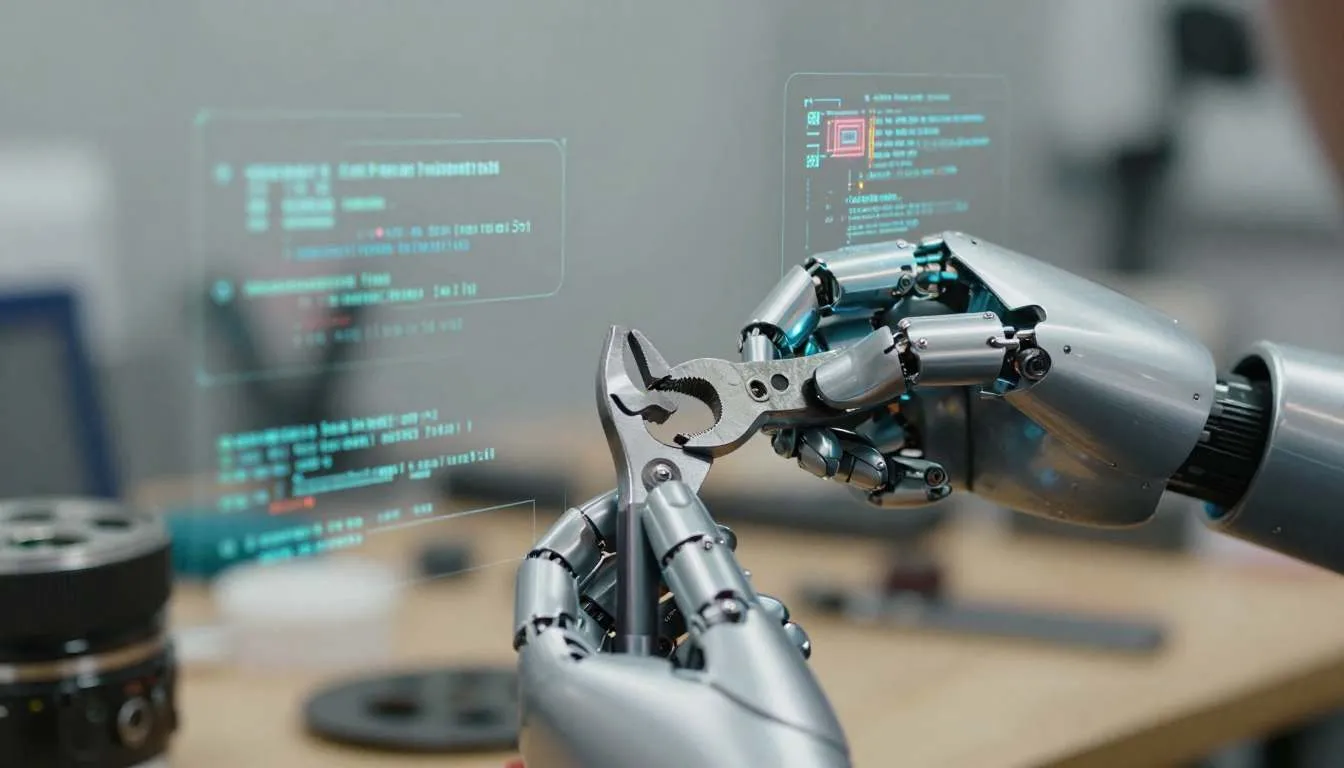
You've watched Boston Dynamics robots do backflips for years. You've seen Tesla's Optimus demos. You've sat through countless conference presentations promising that "general-purpose humanoid robots are just around the corner."
But here's what nobody wants to admit: those backflipping robots are still basically expensive remote-controlled toys that can't figure out how to pick up a cup if you move it three inches to the left.
I know this hits home for robotics engineers who've spent the last decade fighting with rigid motion primitives and hand-coded behaviors. You've built incredible hardware—actuators that rival human dexterity, sensors that exceed human perception, control systems that maintain balance better than any animal. The mechanical engineering is solved.
Yet your million-dollar robot still can't understand a simple instruction like "put the tools back on the shelf" without someone spending weeks programming every single movement for that specific shelf configuration.
The gap between what robots can do and what they should do has never been wider. Until now.
Something fundamental has shifted in 2026. We're not talking about incrementally better motion planning or slightly more robust grasping. We're talking about a complete architectural rethink: Physical AI—the merger of large language models with robotic embodiment that's finally making Humanoid Robotics 2026 actually practical.
The Problem: Brilliant Hardware, Stone-Age Software
Let's be honest about where we've been stuck.
The robotics industry has operated under a paradigm that made sense in 1985 but looks increasingly absurd in 2026: explicitly program every behavior the robot might need, hope you've covered all the edge cases, and watch it fail spectacularly when it encounters anything unexpected.
The Classical Robotics Trap
Traditional robotic systems operate through a pipeline that any robotics engineer knows by heart:
- Perception: Process sensor data to build a world model
- Planning: Calculate trajectories and actions based on that model
- Control: Execute those plans through motor commands
Seems logical. And it works—for highly structured environments where you control all the variables.
But real-world environments are messy. Objects aren't always where they're supposed to be. Lighting changes. Materials have unexpected properties. Humans do unpredictable things.
The classical approach requires you to anticipate and explicitly code responses to every possible variation. You end up with:
- Massive behavior trees with thousands of conditional branches
- Fragile systems that break when encountering novel situations
- Months of programming for each new task
- Complete inability to generalize across different but similar tasks
A robot trained to pick up red blocks can't pick up blue blocks. A robot programmed for one warehouse layout needs complete reprogramming for a different warehouse. It's absurd when you step back and look at it.
The Learning Approaches That Didn't Quite Work
"But wait," you might say, "we've had reinforcement learning and imitation learning for years now. Aren't those supposed to solve generalization?"
In theory, yes. In practice, not really.
Reinforcement learning requires millions of interactions to learn even simple behaviors. Great for simulation, terrible for real robots that operate in real-time in the physical world. You can't crash a million-dollar humanoid robot 100,000 times while it learns to walk.
Imitation learning is better but still limited. You can demonstrate tasks, and the robot learns to reproduce them. But it only learns the specific motions you showed it, not the underlying intent. Change the environment slightly, and you're back to square one.
Deep learning perception has helped enormously with understanding visual scenes. But understanding what you're seeing doesn't automatically tell you what to do about it.
The fundamental issue? None of these approaches bridge the gap between high-level reasoning and low-level motor control.
Humans don't need explicit programming or millions of practice attempts to figure out how to put dishes away in a new kitchen. We understand language, we understand physics, we understand goals, and we figure out the details on the fly.
Robots couldn't do that. Past tense. Because something changed.
The Solution: Vision-Language-Action Models and Embodied AI
Here's the breakthrough that's transforming Humanoid Robotics 2026: Multi-modal LLM Robots that directly map from natural language instructions and visual input to physical actions.
Instead of the classical perception-planning-control pipeline, we now have models that directly reason about what needs to happen and how to make it happen, all in one integrated system.
Let me explain how this actually works and why it changes everything.
Understanding Vision-Language-Action (VLA) Models
Think of VLA models as the child of three different AI breakthroughs:
Large Language Models (LLMs): Understand instructions, reason about tasks, break down complex goals into steps.
Vision Transformers: Process visual information and understand spatial relationships, object properties, and scene context.
Action Models: Directly output motor commands and trajectories that accomplish physical goals.
Traditional robotics kept these capabilities separate. You'd have one system for understanding language, another for computer vision, another for motion planning, and fragile interfaces connecting them all.
VLA models train these capabilities together in a single unified model. The same neural network that understands "put the red mug on the top shelf" also understands what "red mug" and "top shelf" look like in the visual input, and directly outputs the sequence of actions to accomplish the task.
Why this matters: The model learns the connections between language concepts, visual perception, and physical actions. It doesn't just understand words—it understands how those words relate to things it can see and actions it can take.
How Embodied AI Changes the Game
Embodied AI is the recognition that intelligence doesn't exist in a vacuum—it emerges from interaction with the physical world.
Previous approaches trained models in simulation or on datasets of images and text. Then they hoped that knowledge would transfer to real robots. Sometimes it did. Often it didn't.
Modern Embodied AI trains directly on physical interaction data:
- Millions of hours of teleoperated robot demonstrations
- Multi-modal datasets linking vision, language, and action
- Transfer learning from simulation and real-world experience
- Continuous learning as robots encounter new situations
Models like Google's RT-2, Physical Intelligence's π0 (pi-zero), and others train on diverse robotic manipulation data across different robots, different objects, and different environments.
The result? Genuine generalization. A robot trained on one set of objects can manipulate novel objects it's never seen before. A robot trained in one environment can adapt to new environments without retraining.
The Technical Architecture: How This Actually Works
For robotics engineers wondering about implementation, here's the practical architecture.
Component 1: Multi-Modal Perception Foundation
Modern VLA systems use vision transformers trained on internet-scale image and video data, fine-tuned for robotic perception:
Visual Input (RGB-D camera feeds)
    ↓
Vision Transformer Encoder
    ↓
Spatial Understanding + Object Recognition
    ↓
Scene Representation (tokens)
Key capability: The model doesn't just detect objects—it understands their affordances, physical properties, and relationships. It knows a mug has a handle, that liquids can spill, that fragile objects need gentle handling.
Component 2: Language Understanding and Reasoning
The language model component processes natural language instructions and provides reasoning capabilities:
Natural Language Instruction
    ↓
Language Model Processing
    ↓
Task Decomposition + Goal Understanding
    ↓
Instruction Representation (tokens)
Key capability: The model can handle ambiguous instructions, ask clarifying questions, and break complex tasks into subtasks. "Clean the kitchen" becomes a sequence of specific actions based on what it sees.
Component 3: Vision-Language-Action Integration
This is where the magic happens—a transformer-based architecture that jointly processes visual and language tokens:
[Visual Tokens] + [Language Tokens]
    ↓
Cross-Modal Transformer Layers
    ↓
Joint Reasoning about Perception + Intent
    ↓
Action Tokens (motor commands, trajectories)
The model learns the relationships between "grasp the red object" (language), the visual appearance of red objects in the scene, and the specific motor commands needed to approach and grasp them.
Component 4: Action Execution and Feedback
Finally, action tokens get decoded into actual robot control:
Action Tokens
    ↓
Action Decoder
    ↓
Joint Positions / End-Effector Trajectories
    ↓
Low-Level Motor Controllers
    ↓
Physical Robot Movement
Crucially, the system operates in a closed loop—visual feedback continuously updates the model's understanding, allowing real-time adaptation if something unexpected happens.
Real-World Applications Already Deployed
This isn't vaporware or research demos. Physical AI systems are entering production environments right now.
Manufacturing and Warehouse Operations:
Tesla's Optimus robots in their factories now use VLA models to handle diverse manipulation tasks. Instead of programming specific pick-and-place routines for every component, human operators give high-level instructions: "organize the battery components by size" or "move these parts to the assembly station."
The robots figure out the details—how to grasp each object, what order to work in, how to handle unexpected variations in part placement.
Result: Task programming time drops from days to minutes. Robots adapt to production changes without reprogramming.
Elder Care and Assistance:
Embodied AI systems from companies like Agility Robotics and Apptronik are entering pilot programs for elderly assistance. These Humanoid Robotics 2026 systems can:
- Fetch items from around the home based on verbal requests
- Assist with meal preparation (chopping vegetables, retrieving ingredients)
- Help with basic cleaning and organization
- Provide physical support for mobility assistance
Key advantage: Each home is different, but VLA models allow the robots to generalize. They don't need custom programming for every house layout or every person's specific needs.
Research and Laboratory Automation:
Multi-modal LLM Robots are being deployed in research labs for:
- Automated chemistry experiments (handling labware, measuring reagents)
- Biological sample preparation and handling
- Equipment maintenance and calibration
- Data collection and documentation
Why this works: Research protocols are complex and often change. Traditional automation couldn't adapt. VLA-based robots can follow written protocols with minimal human supervision.
Training Your Own VLA System: A Practical Guide
For robotics teams looking to implement Physical AI, here's your roadmap.
Phase 1: Data Collection Infrastructure (Months 1-2)
You need high-quality training data linking vision, language, and action.
Hardware setup:
- Multiple camera angles (wrist-mounted, external views, depth sensors)
- High-frequency state logging (joint positions, forces, end-effector poses)
- Teleoperation system for human demonstrations
- Synchronized data capture pipeline
Data collection strategy:
-
Diverse task demonstrations: Have operators perform 50-100 examples of each core task with variations in object placement, approach angles, and execution strategies.
-
Language annotations: For each demonstration, record natural language descriptions at multiple granularities:
- High-level goal: "Put away the groceries"
- Mid-level steps: "Pick up the can", "Place in pantry"
- Low-level actions: "Grasp with power grip", "Lift slowly"
-
Failure cases: Deliberately include examples of corrections and error recovery. These teach the model robustness.
Target dataset size: Minimum 10,000 demonstrations across at least 100 different task variations. More is better.
Phase 2: Model Architecture Selection (Month 2-3)
Choose your foundation models and integration approach.
Option A: Fine-tune existing VLA models
- Start with RT-2, OpenVLA, or π0 base models
- Fine-tune on your specific robot morphology and tasks
- Fastest path to deployment (weeks vs. months)
- Limited customization of core architecture
Option B: Build custom VLA from components
- Vision: Fine-tuned DINOv2 or CLIP
- Language: Llama 3 or Phi-3 for reasoning
- Action: Custom action head trained on your robot data
- Full control but requires ML expertise
- 3-6 months development time
Recommendation for most teams: Start with Option A. The open-source VLA models are remarkably capable and transfer well to new robots with modest fine-tuning.
Phase 3: Training Pipeline (Month 3-5)
Training strategy:
-
Pre-training on diverse robot data: If using a custom model, pre-train on publicly available datasets (Open X-Embodiment, RoboSet, etc.)
-
Fine-tuning on your specific robot: Train on your collected demonstration data with emphasis on your robot's unique characteristics
-
Sim-to-real transfer: Use simulation to generate additional training data for edge cases and failure modes
-
Continual learning: Implement systems for the robot to improve from deployment experience
Technical considerations:
- Compute requirements: Expect to need 8x A100 GPUs for 2-4 weeks for full training
- Hyperparameter tuning: Vision-Language-Action models have different optimal settings than pure vision or language models
- Evaluation metrics: Track both language understanding accuracy and physical task success rate
Phase 4: Deployment and Iteration (Month 5-6)
Roll out progressively with safety systems in place.
Deployment checklist:
✓ Safety constraints: Hard-coded limits on joint velocities, forces, workspace boundaries
✓ E-stop integration: Immediate shutdown on anomaly detection
✓ Human oversight: Remote monitoring for early deployments
✓ Graceful degradation: Fallback to simpler behaviors if VLA model is uncertain
✓ Logging infrastructure: Capture all failures for continuous improvement
Progressive rollout:
- Week 1-2: Supervised operation—human verifies every action before execution
- Week 3-4: Semi-autonomous—human monitors but doesn't need to approve each action
- Week 5+: Fully autonomous operation with periodic human check-ins
Addressing the Hard Questions
Let me tackle the concerns that every industrialist and tech journalist asks about Physical AI.
"Is this safe enough for human environments?"
Modern VLA systems include multiple safety layers:
- Learned safety constraints: The models learn what behaviors are dangerous through training
- Uncertainty quantification: Models can detect when they're unsure and ask for help
- Hard-coded bounds: Traditional safety systems still provide ultimate backstops
- Real-time monitoring: Anomaly detection shuts down unsafe behaviors immediately
Are they perfect? No. But they're reaching safety levels comparable to human workers in many scenarios, with the advantage of perfect attention and consistent behavior.
"What about the computational requirements?"
This is legitimate. Early VLA models required cloud connectivity and significant compute.
But the trend is clear: model compression and efficient architectures are making on-robot inference practical.
Current state (2026):
- Quantized VLA models run on edge GPUs (Jetson Orin, Apple Silicon)
- Inference latency: 50-200ms for action generation
- Power consumption: 15-40W depending on model size
This is manageable for mobile robots and entirely feasible for stationary industrial systems.
"How do we validate and certify these systems?"
Fair question with no perfect answer yet. The industry is developing new testing frameworks:
- Scenario-based testing: Comprehensive test suites covering expected situations and edge cases
- Out-of-distribution detection: Measuring model ability to recognize novel situations
- Explainability tools: Understanding why the model chose specific actions
- Continuous monitoring: Tracking performance metrics in production
Regulatory frameworks are evolving. ISO standards for AI-based robotics are in development. Early adopters work closely with regulators to establish safety cases.
"What's the ROI compared to traditional automation?"
The economics favor Physical AI for tasks requiring flexibility:
Traditional automation:
- High upfront engineering cost ($100K-$1M per installation)
- Low flexibility—can't adapt to changes without reprogramming
- Perfect for high-volume, unchanging tasks
Physical AI systems:
- Moderate upfront cost ($50K-$200K for robot + training)
- High flexibility—adapt to new tasks with demonstration, not programming
- Perfect for variable tasks, changing products, uncertain environments
Break-even point: For tasks that change monthly or require handling diverse objects, Physical AI pays for itself in 6-18 months through reduced programming costs.
The Ecosystem: Tools and Platforms
You don't need to build everything from scratch. The Physical AI ecosystem has matured rapidly.
Open-Source Foundations:
- OpenVLA: Open-source VLA model trained on diverse robot data
- PyRobot: Unified interface for robot control
- ROS 2 Humble: Modern robot middleware with better real-time performance
- Isaac Gym/MuJoCo: Physics simulation for generating training data
Commercial Platforms:
- Physical Intelligence π0: Pre-trained VLA models as a service
- Intrinsic (Google X): Industrial robotics with built-in VLA capabilities
- Covariant: Warehouse automation using brain-inspired AI
- Sanctuary AI: Full-stack humanoid systems with VLA architecture
Hybrid approach (recommended): Use open-source for development and testing, commercial platforms for production deployment with support and guarantees.
The Implications: What This Means for Your Industry
Let's talk about what Physical AI means in practical terms for different stakeholders.
For Robotics Engineers
Your job isn't disappearing—it's evolving in an exciting direction.
Less time on:
- Hand-coding motion primitives
- Debugging complex behavior trees
- Tuning dozens of parameters for each task
More time on:
- Collecting high-quality demonstration data
- Designing effective training curricula
- Optimizing model architectures for specific robots
- Ensuring safety and robustness
You're shifting from programming specific behaviors to teaching general capabilities. It's more interesting work with faster iteration cycles.
For Industrialists
The business case for humanoid robotics just became compelling.
Previous barrier: Custom automation was too expensive unless you had enormous, unchanging production volumes.
New reality: Flexible automation adapts to changing products, processes, and layouts without expensive reprogramming.
Strategic implications:
- Smaller production runs become economically viable
- Rapid product changes don't require automation overhauls
- Labor shortages in developed markets become less constraining
- New factory designs optimize for human-robot collaboration
Investment timeline: Expect 5-7 year payback periods for early adopters, dropping to 2-3 years as systems mature.
For Tech Journalists
You're watching the emergence of a genuinely new technology category.
This isn't incremental improvement. This is the kind of architectural shift that creates new industries and transforms existing ones.
Story angles to explore:
- Which companies are actually deploying vs. just demoing?
- How are workers responding to AI-powered robots in their workplaces?
- What regulatory challenges are emerging?
- Where will the first large-scale deployments happen?
- Which traditional automation companies will successfully adapt?
Prediction: By 2028, stories about "teaching robots through demonstration" will sound as quaint as stories about "programming computers with punch cards" do today.
The Road Ahead: What to Expect in the Next 24 Months
Physical AI is at an inflection point. Here's what I expect we'll see by 2028.
Technical milestones:
- VLA models running entirely on-robot with no cloud dependency
- Multi-robot coordination through shared language understanding
- Robots learning new tasks from video demonstrations (not just teleoperation)
- Integration of tactile and force sensing into VLA models
Market developments:
- 100,000+ humanoid robots in production environments (up from ~5,000 today)
- First consumer-grade household robots with genuine usefulness
- Major automotive manufacturers deploying VLA-based robots at scale
- Insurance and liability frameworks for Physical AI systems
The bottleneck isn't technology anymore—it's production capacity, regulatory clarity, and workforce adaptation.
Your Next Move: Getting Started with Physical AI
Whether you're building robots, deploying them, or covering the industry, here's your action plan.
For robotics engineers:
- This month: Download and experiment with OpenVLA or RT-2 in simulation
- Next quarter: Collect a small demonstration dataset on your robot
- This year: Deploy your first VLA-powered capability in a controlled environment
For industrialists:
- This month: Identify your top 5 automation pain points where flexibility matters
- Next quarter: Run pilots with Physical AI vendors on your highest-priority use case
- This year: Develop your 3-year roadmap for flexible automation deployment
For tech journalists:
- This month: Visit a deployment site—see these systems in action, not just in demos
- Next quarter: Interview workers using these systems daily
- This year: Track which predictions come true and which don't
The merging of language models with physical robotics isn't coming—it's here. The question is whether you'll be ahead of the curve or scrambling to catch up.
We're not talking about incremental improvements to robotic capabilities. We're talking about a fundamental rethinking of how robots understand and interact with the world. The gap between "can do backflips" and "can actually be useful" is finally closing.
And unlike most AI hype, this one is real, deployable, and getting better every month.
Ready to dive deeper into Physical AI? Start experimenting with open-source VLA models this week, join the robotics communities sharing deployment experiences, and keep your eyes on the companies actually shipping products, not just demos.
The robot-LLM merger is the most important development in robotics since the industrial robot arm. Make sure you're part of it.