AI-Assisted 3D Design with Three.js Tiny Shader Language (TSL) for Immersive Web Experiences
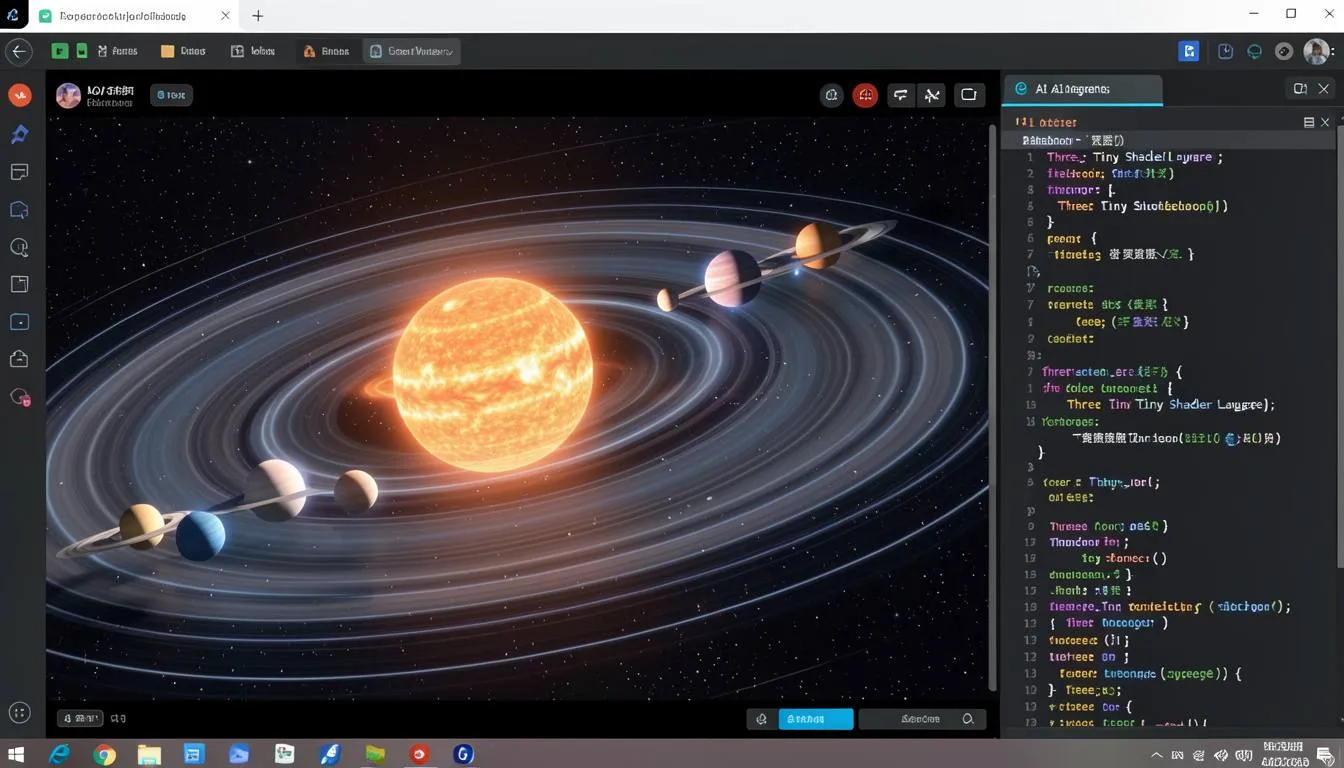
AI Design: Designing Immersive Web Experiences with TSL and AI Agents
🔑 Key Takeaways
- Three.js Tiny Shader Language (TSL) enables advanced shader effects without deep GLSL expertise
- AI-assisted 3D design reduces dependency on specialized graphics engineers
- Web-based 3D games and immersive product experiences are now viable for mainstream SaaS teams
- Agent “skills” can teach AI brand-new frameworks like TSL instantly
- Platforms like Antigravity playground demonstrate how agent-driven UI creation accelerates innovation
- Case Study: The Solar System Game proves that a simple skill file can unlock production-grade 3D animation
The Web Is Flat. Your Users Aren’t.
Let’s be honest.
Most SaaS websites still feel… flat.
Scrolling pages. Static dashboards. Mild hover animations.
Meanwhile, your competitors are experimenting with immersive storytelling, interactive UI design, and web-based 3D games that feel closer to product demos than marketing sites.
As a product manager or CTO, you’re stuck between two realities:
- You want immersive web experiences.
- You don’t have a dedicated graphics engineering team.
Hiring shader experts is expensive.
Learning GLSL takes time.
And real-time 3D optimization can derail roadmaps fast.
So most teams default to safe.
But safe doesn’t convert like immersive does.
The Core Problem: Talent Bottlenecks in 3D Web Design
Here’s the underlying challenge.
Modern web engines like :contentReference[oaicite:0]{index=0} make 3D rendering possible in the browser.
But pushing beyond basic shapes into cinematic lighting and shader effects requires:
- Shader programming knowledge
- Performance optimization expertise
- GPU rendering awareness
- Deep math familiarity
For leadership teams balancing product delivery and innovation, this creates friction.
You either:
- Overinvest in niche talent
- Outsource expensive interactive campaigns
- Or abandon immersive ambitions
If ignored, this gap impacts more than aesthetics.
It affects:
- Engagement metrics
- Product storytelling
- Time-on-site
- Demo-to-signup conversion
In a world where attention is scarce, experience design is strategy.
The Shift: AI-Assisted 3D Design + TSL
Now, something important has changed.
AI agents can generate complex 3D scenes.
But more importantly?
They can learn new languages instantly.
Enter :contentReference[oaicite:1]{index=1} (TSL).
TSL simplifies shader authoring within Three.js, reducing boilerplate while retaining expressive control.
However, because it’s new, most large models don’t deeply “know” it yet.
That’s where agent skills come in.
By providing a structured skill file describing TSL syntax and best practices, you enable an AI agent to:
- Generate shader-driven animations
- Create lighting effects
- Build interactive 3D components
- Follow your performance constraints
No retraining required.
Just structured knowledge injection.
Case Study: The Solar System Game
A designer wants to build a browser-based solar system demo.
In the past, this would require:
- A Three.js developer
- A shader engineer
- Weeks of iteration
Instead, they used an agent in the :contentReference[oaicite:2]{index=2}.
Step one: Provide a TSL skill file explaining:
- Shader structure
- Animation timing functions
- Light scattering simulation
- Performance optimization tips
Step two: Prompt the agent:
“Build a 3D solar system with realistic planetary rotation, glowing sun shader, and subtle orbit trails.”
The agent:
- Generated scene setup code
- Applied TSL-based shaders
- Added animated glow effects
- Implemented camera controls
The result?
A high-end, shader-based 3D experience that would normally require a specialized graphics engineer.
That’s AI-assisted 3D design in action.
Why This Matters for Enterprise Teams
1. It Reduces Specialized Hiring Pressure
Instead of hiring for rare GPU expertise, you:
- Encode shader knowledge in skills
- Reuse it across projects
- Iterate faster
This makes immersive design accessible to mainstream teams.
2. It Accelerates Web-Based 3D Games and Interactive UI Design
Interactive demos are no longer just for gaming companies.
Product walkthroughs.
Data visualizations.
Onboarding simulations.
All can benefit from web-based 3D games logic.
According to research from :contentReference[oaicite:3]{index=3}, interactive experiences significantly improve user engagement and recall when thoughtfully implemented.
AI reduces the barrier to experimentation.
3. It Aligns with Broader Agentic Workflows
AI design isn’t isolated.
It connects to:
- Marketing automation
- Personalization engines
- Real-time analytics
For deeper insights into orchestrating AI-driven workflows across product and marketing, SaaSNext offers practical frameworks here: 👉 https://saasnext.in/blog/ai-automation-strategies
Immersive design should plug into your broader enterprise AI stack.
Not live in isolation.
Practical Framework: Deploying AI + TSL in Production
Step 1: Define Your Experience Goal
Are you building:
- A product demo?
- A landing page hero animation?
- An educational mini-game?
Start with business outcomes, not graphics.
Step 2: Create a TSL Skill Specification
Your skill file should include:
- Shader syntax examples
- Animation patterns
- Performance constraints (FPS limits)
- Brand color and lighting guidelines
This ensures consistent interactive UI design.
Step 3: Use an Agent-Enabled Environment
Tools like Antigravity playground enable agents to:
- Read skill files
- Generate modular 3D components
- Iterate quickly
Meanwhile, SaaSNext supports organizations adopting AI agents across marketing and product workflows: 👉 https://saasnext.in/
Bridging design agents with marketing agents creates measurable ROI.
Step 4: Optimize for Performance
AI-generated 3D must be production-ready.
Focus on:
- Texture compression
- Frame-rate monitoring
- Mobile fallback rendering
- Lazy-loading assets
Immersion means nothing if performance drops.
Common Questions (AEO Optimized)
What is Three.js Tiny Shader Language (TSL)?
TSL is a simplified shader authoring layer within Three.js that makes advanced visual effects easier to implement without complex GLSL coding.
Can AI really design 3D web experiences?
Yes. With structured skill inputs, AI agents can generate scenes, shaders, animations, and interaction logic.
Are web-based 3D games practical for SaaS companies?
Absolutely. They enhance onboarding, storytelling, and engagement when aligned with business goals.
How does AI-assisted 3D design reduce costs?
It minimizes dependency on specialized graphics engineers and accelerates iteration cycles.
The Bigger Strategic Insight
Immersive web isn’t about flash.
It’s about differentiation.
As AI agents become more capable, the competitive edge shifts from “who can code shaders” to:
“Who can structure intelligence effectively?”
TSL + AI agents represent a new pattern:
- Lightweight skill injection
- Rapid iteration
- Enterprise-aligned design
And for CTOs, that means immersive capability without architectural chaos.
The Future Is Interactive
The web is evolving from static interfaces to spatial experiences.
The question isn’t whether 3D belongs in enterprise UX.
It’s whether you can deploy it efficiently.
By combining:
- Three.js Tiny Shader Language
- AI-assisted 3D design
- Structured agent skills
You unlock immersive design without rebuilding your team.
If you’re exploring AI-powered workflows across product and marketing, SaaSNext provides structured pathways to scale responsibly.
Subscribe for more insights on enterprise AI strategy, share this with your design and engineering leads, and start building web experiences that feel alive.
Because in a crowded market, flat doesn’t win.