Character Consistency Is Solved: The Ultimate Guide for AI Brand
You’ve poured weeks into building your AI influencer.
You’ve crafted her personality: witty, eco-conscious, always in oversized blazers.
You’ve scripted her voice, designed her color palette, even named her (“Zara Lux”).
You hit generate in Midjourney…
And she comes back with a different face.
And neon green hair.
And no blazer.
Again.
If this makes you want to throw your laptop out the window—you’re not alone.
For years, AI character consistency felt like chasing smoke. Every image was a surprise. Every post risked brand confusion. And your audience? They started wondering if “Zara” had an identity crisis.
But here’s the good news: as of 2026, character consistency is no longer a myth.
Thanks to breakthroughs in AI character consistency workflows, reference image locking, and smart prompt engineering, you can now generate the same character—across poses, outfits, and lighting—with pixel-perfect reliability.
This isn’t just a creative win.
It’s a branding revolution.
And if you’re still relying on luck with random seeds? You’re leaving engagement, trust, and revenue on the table.
The Problem: Inconsistent AI Characters Erode Brand Trust
Let’s be real: your audience doesn’t care about your “cool AI experiment.”
They care about recognizable, relatable characters they can connect with.
But when your AI influencer:
- Has five different eye colors in one week
- Switches from 20s to 40s in age overnight
- Wears luxury streetwear one day and gym shorts the next
…you’re not building a persona.
You’re creating noise.
And noise gets ignored.
Worse, inconsistency undermines professional credibility. Imagine a beauty brand whose AI ambassador keeps changing skin tone or facial structure. Customers won’t just scroll past—they’ll assume you don’t care about details (or diversity).
If you ignore this, you’ll face:
- Lower follower retention (people don’t bond with a shape-shifter)
- Higher content fatigue (your feed looks chaotic, not curated)
- Failed collaborations (brands won’t partner with an unstable “face”)
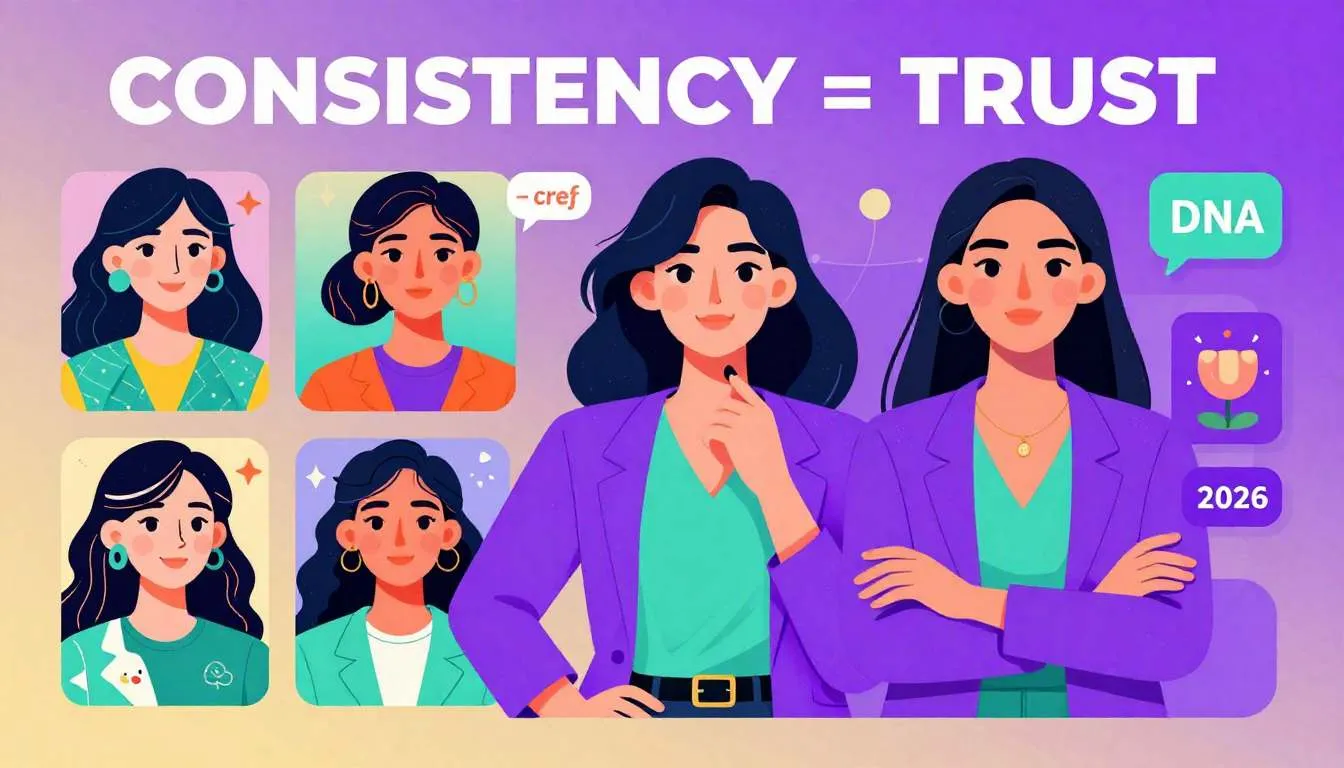
In the attention economy, consistency = trust.
And trust = conversion.
The Solution: How to Lock AI Character Consistency in 2026 (Step by Step)
The secret isn’t magic—it’s method.
Here’s how top creative directors and AI-first brands are solving character consistency once and for all.
1. Build a “Character DNA” Kit (Your Non-Negotiable Foundation)
Before you generate a single image, define your character’s immutable traits in a Character DNA Kit:
- Facial structure: heart-shaped face, high cheekbones, narrow chin
- Hair: jet black, shoulder-length, blunt cut with curtain bangs
- Eyes: almond-shaped, dark brown, thick lashes
- Style signature: oversized blazers, vintage denim, chunky gold hoops
- Color palette: charcoal, cream, burnt orange, matte black
- Vibe keywords: “thoughtful rebel,” “urban minimalist,” “warm but sharp”
Why it works: AI models respond to specificity. Vague prompts like “cool woman” yield chaos. Precise DNA yields control.
Action step: Create a one-page PDF with reference sketches, Pantone codes, and written descriptors. Share it with every team member—and your AI.
2. Master Midjourney 2026’s Consistency Tools (No More Guesswork)
Midjourney v6.5 (2026) finally cracked the code. Use these features like a pro:
- Character Reference (–cref): Upload a single approved portrait. Midjourney locks facial structure, skin tone, and hair across all future generations.
- Style Reference (–sref): Apply consistent lighting, texture, and mood (e.g., “cinematic dusk” or “studio flat light”).
- Custom Stylization (--style raw + --s 150): Reduces Midjourney’s default “artistic drift” for photorealistic reliability.
Pro prompt template:
Zara Lux, [action], wearing [outfit], [setting] --cref [URL_to_approved_face.jpg] --sref [URL_to_style.jpg] --style raw --s 180
Real example: Fashion brand “Nova AI” uses –cref to generate 50+ Zara Lux posts per month—all with identical facial features, even when she’s skydiving or sipping espresso in Tokyo.
3. Create a Library of “Approved Base Poses”
Don’t generate from scratch every time.
Build a pose library of 5–10 core stances:
- Standing full-body (front/side)
- Seated at desk
- Walking mid-stride
- Close-up talking expression
Generate these once with perfect –cref alignment. Then, reuse them as starting points for new outfits or scenes using img2img or Midjourney’s Vary (Subtle) feature.
Why it works: You’re editing, not regenerating—so bone structure and proportions stay locked.
For influencers: This cuts production time by 70%. One approved base = 20+ on-brand variations.
4. Enforce Consistent Brand Assets Across All Outputs
Your AI character doesn’t exist in a vacuum. She lives in a world—and that world needs rules too.
- Backgrounds: Only use 3–5 branded locations (e.g., your studio, a moody café, a rooftop garden)
- Props: Limit to signature items (e.g., a specific tote bag, vintage camera, or coffee mug)
- Typography: Always pair images with the same font and caption style
Use AI asset managers like Kive or Artflow to auto-tag and filter approved visuals—so your social team never posts an off-brand frame.
5. Train Your Own LoRA for Ultimate Control (Advanced but Worth It)
For brands serious about ownership, train a custom LoRA (Low-Rank Adaptation) on your character.
- Takes ~50 high-quality images of your character (real or AI-generated)
- Fine-tunes an open model (like SDXL or Flux) to only generate “Zara”
- Works in local tools (ComfyUI, Fooocus) or cloud platforms (Runway, Leonardo)
Why go this route?
- Full control (no reliance on Midjourney’s terms or outages)
- Can generate video, 3D, and voice-synced content later
- True consistent brand assets you legally own
“Our LoRA pays for itself in 2 weeks—we repurpose the same character for Instagram, YouTube Shorts, and product mockups.”
— Creative Director, AI-First Beauty Brand
6. Answer the Big Questions (Straight Talk for Busy Creators)
Q: Do I need to pay for Midjourney Pro to get –cref?
A: Yes—as of 2026, Character Reference is a Pro-only feature. But it’s worth every penny if you’re building an AI influencer.
Q: Can I use this for multiple characters?
A: Absolutely. Just create separate –cref links for each. Pro tip: name your reference files clearly (“Zara_face_v3.jpg”, “Kai_face_closeup.jpg”).
Q: What if my character needs to age or change style slightly?
A: Create a new DNA version (e.g., “Zara 2.0 – Summer Edition”) and generate a new –cref. Don’t try to force major changes on the same reference.
Q: Is this just for influencers?
A: No! Use it for:
- Product mascots
- Tutorial avatars
- Branded customer service agents
- NFT collections with consistent traits
The Bigger Win: From Gimmick to Genuine Connection
When your AI character looks, feels, and acts like a real person—consistently—something powerful happens.
Your audience stops seeing “an AI.”
They see a friend.
And friends trust. They engage. They buy.
In 2026, the most successful AI brands won’t be the ones with the flashiest tech.
They’ll be the ones with the most human, consistent characters—built with intention, not randomness.
Your Turn: Stop Generating. Start Building.
You don’t need to be a prompt engineer to master this.
You just need to start.
✅ This week: Define your character’s DNA in one page. No fluff—just concrete traits.
✅ This month: Generate one perfect –cref portrait in Midjourney 2026. Lock it. Reuse it 10x.
✅ This quarter: Build a pose + prop library so your team can scale without losing consistency.
The era of “AI character roulette” is over.
Now, you get to design your avatar like a real brand asset—because that’s exactly what it is.
→ Share your first consistent AI character with #AIBrandDNA
→ Download our free “AI Character Consistency Checklist” (link in bio)
→ Tag a creator who’s tired of AI giving them a new face every day
Because in 2026,
consistency isn’t a bug—it’s your superpower.