Embodied AI in 2026: How Physical AI Is Transforming Logistics and Labor
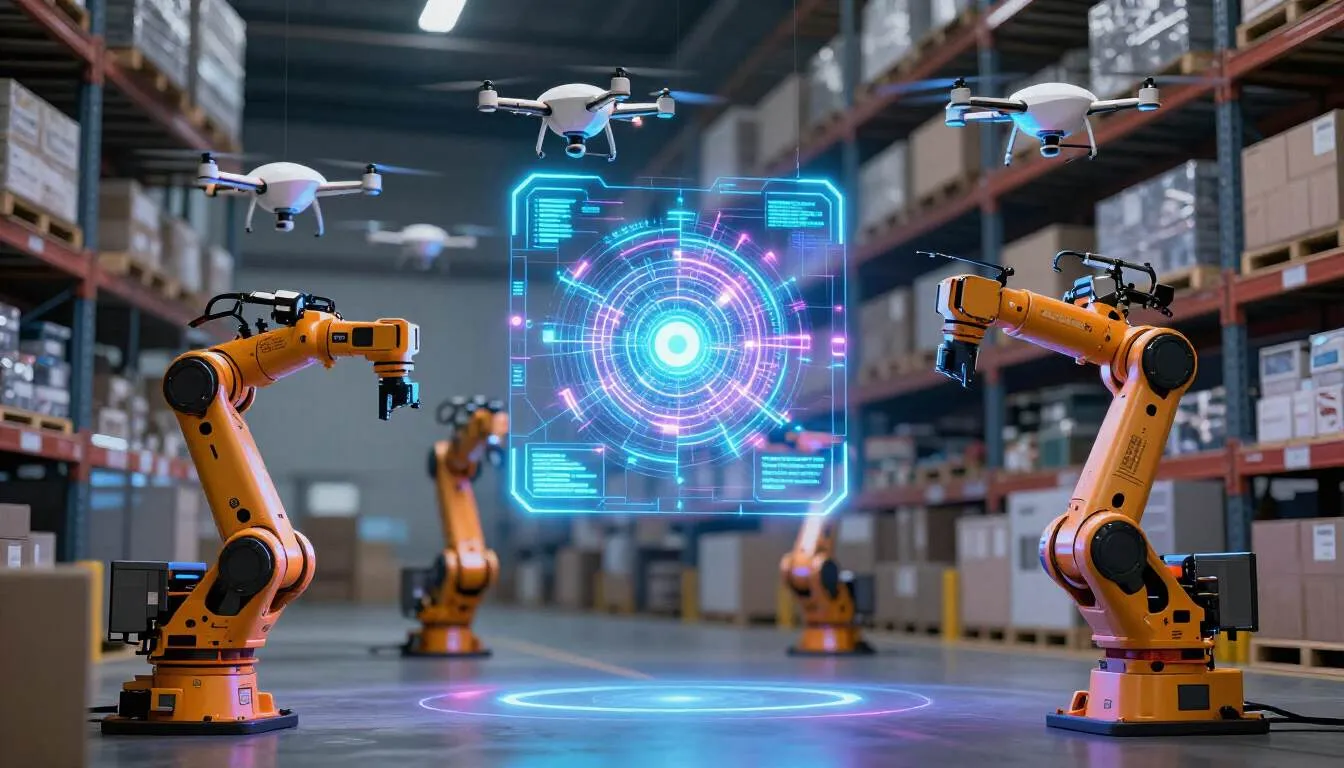
Embodied AI in 2026: When Artificial Intelligence Steps Off the Screen and Into the Real World
What happens when AI stops answering prompts… and starts opening doors, moving packages, and navigating city streets?
If you’re an e-commerce founder struggling with delivery timelines, a marketer watching fulfillment costs eat into margins, or a growth leader wondering how “AI” suddenly became a logistics issue—this is the shift you’re feeling.
In 2026, AI is no longer something you “use.”
It’s something that moves, lifts, drives, and decides in the physical world.
This is the year of Embodied AI—and it’s already rewriting the rules of scale, speed, and survival.
The Reality Check: AI Has Left the Browser
For the last decade, AI lived on screens:
- Chatbots
- Dashboards
- Recommendation engines
- Campaign optimizers
Powerful, yes—but abstract.
In 2026, that abstraction is gone.
AI is now:
- Walking warehouse floors
- Flying drones over cities
- Sorting inventory
- Navigating traffic
- Responding to real-world uncertainty in milliseconds
This isn’t a future concept. It’s Physical AI 2026, and it’s arriving faster than most businesses are prepared for.
The Problem: Digital Intelligence Alone Can’t Fix Physical Bottlenecks
Let’s talk about the pressure everyone feels but few articulate clearly.
Labor Shortages Are Now Structural
This isn’t a temporary hiring dip.
- Warehouses are understaffed
- Last-mile delivery is fragile
- Skilled logistics labor is scarce
No amount of ad spend or CRO optimization fixes a fulfillment delay.
Software AI Hit a Ceiling
Traditional AI systems excel at:
- Prediction
- Analysis
- Content generation
But the real world isn’t clean data. It’s:
- Crowded
- Noisy
- Unpredictable
Static automation scripts break the moment reality changes.
The Cost of Inaction Is Compounding
If you ignore this shift:
- Delivery windows widen
- Customer trust erodes
- Margins collapse under operational inefficiency
Marketing promises mean nothing if logistics can’t keep up.
This is why Embodied AI isn’t an “operations trend.”
It’s a growth and survival strategy.
What Is Embodied AI (In Plain English)?
Embodied AI is when intelligence isn’t just thinking—it’s acting.
It combines:
- Perception (seeing, sensing)
- Reasoning (understanding context)
- Action (moving in the physical world)
At the core are VLA Models (Vision-Language-Action)—AI systems that connect:
- What they see
- What they understand
- What they do next
This is the missing link between software intelligence and physical execution.
Why 2026 Is the Inflection Point
Three forces collided this year.
1. Breakthroughs in VLA Models
VLA models allow robots and drones to:
- Interpret visual scenes
- Understand natural language instructions
- Execute physical actions safely
They don’t just follow rules—they reason spatially.
2. Edge AI Processing Went Mainstream
Instead of sending data to the cloud:
- Decisions happen on-device
- Latency drops to near-zero
- Systems keep working offline
This is critical for:
- Autonomous logistics
- Humanoid robotics
- Urban navigation
3. Economics Finally Made Sense
Hardware costs dropped. AI coordination improved. ROI became undeniable.
This is the same curve smartphones rode—just faster.
Case Study: Amazon’s “DeepFleet” Robotics Orchestration
To understand Embodied AI at scale, look past the robots.
Look at the brain.
The Challenge
Amazon crossed a staggering milestone in 2026:
- 1 million robots deployed globally
But scale introduced chaos:
- Traffic congestion inside warehouses
- Inefficient routing
- Micro-delays compounding into hours
Managing robots individually stopped working.
The AI Solution: DeepFleet
Amazon introduced DeepFleet AI, a physical orchestration system.
Instead of treating robots as units, DeepFleet treats:
The entire warehouse as a single intelligent organism.
How it works:
- Every robot acts like a “neuron”
- Real-time spatial data feeds a central reasoning model
- Traffic jams are predicted before they happen
- Paths are dynamically re-routed
Accuracy: 99% coordinated movement precision
The Result
- 10% increase in travel efficiency across the global fleet
- Sustained 1-hour delivery windows
- Reduced dependency on scarce human labor
This is Autonomous Logistics powered by Embodied AI—and it’s the only reason hyper-fast delivery is still viable in 2026.
The Architecture Behind Physical AI
Let’s break down the system stack.
1. Perception Layer
This includes:
- Cameras
- LiDAR
- Sensors
The AI builds a real-time 3D understanding of its environment.
2. Cognition Layer (VLA Models)
This is where:
- Vision meets language
- Instructions meet context
The system understands:
- “Avoid congestion”
- “Prioritize fragile items”
- “Adapt to human movement”
3. Action Layer
Motors, drones, arms, wheels.
But crucially:
- Actions are reversible
- Decisions are probabilistic
- Safety is baked into reasoning
4. Edge AI Processing
Most decisions happen locally. Why?
- Speed
- Reliability
- Privacy
This is why Edge AI Processing is foundational—not optional.
What This Means for Businesses (Not Just Amazon)
You don’t need a million robots to benefit from this shift.
For E-commerce Founders
Embodied AI enables:
- Faster fulfillment
- Predictable delivery promises
- Lower per-order costs
Your brand promise becomes operationally defensible.
For Marketers and Growth Teams
Here’s the uncomfortable truth:
Growth is now constrained by logistics intelligence.
Campaigns succeed or fail based on:
- Inventory movement
- Delivery speed
- Physical execution
This is why forward-looking teams are aligning marketing intelligence with physical operations—often using orchestration platforms like SaaSNext to bridge AI agents, automation workflows, and real-world execution layers.
For Agencies and Consultants
Static strategy decks won’t cut it.
Winning agencies:
- Understand Physical AI ecosystems
- Advise on AI-driven operations
- Connect digital demand to physical fulfillment
How to Start Adopting Embodied AI (Practical Steps)
You don’t flip this switch overnight. You stage it.
Step 1: Map Physical Bottlenecks
Ask:
- Where does speed break down?
- Where does labor scarcity hurt most?
- Where does variability cause failure?
These are prime candidates for Embodied AI.
Step 2: Instrument the Environment
AI can’t act without perception.
Start with:
- Sensors
- Computer vision
- Real-time tracking
This data layer is the foundation.
Step 3: Introduce AI Orchestration
Don’t automate tasks—coordinate systems.
This is where platforms like SaaSNext play a critical role by helping teams:
- Deploy AI agents
- Orchestrate decision-making
- Connect marketing, ops, and logistics intelligence
Step 4: Pilot Autonomous Loops
Start small:
- A single warehouse zone
- A defined delivery route
- A constrained robotic workflow
Measure:
- Efficiency
- Error rates
- Human intervention reduction
Step 5: Scale Horizontally, Not Vertically
Instead of “bigger robots,” focus on:
- Smarter coordination
- Better prediction
- Faster adaptation
This is how Amazon scaled DeepFleet—not by brute force, but by intelligence.
Common Myths About Embodied AI
“This replaces humans.”
In reality, it replaces shortages and dangerous tasks.
“It’s too complex for mid-sized businesses.”
Cloud AI once felt that way too.
“It’s just robotics.”
Robots are hardware.
Embodied AI is intelligence-in-motion.
The Bigger Shift: Intelligence Is Becoming Spatial
For decades, AI lived in data centers. Now it lives in:
- Warehouses
- Streets
- Stores
- Skies
This changes everything:
- Decision-making moves closer to action
- Feedback loops tighten
- Systems become adaptive, not scripted
This is Humanoid Robotics, Autonomous Logistics, and Physical AI 2026 converging into a single reality.
The Companies That Win Will Think Beyond Screens
Embodied AI isn’t a trend. It’s a graduation.
AI has finished learning how to talk. Now it’s learning how to move.
The winners of 2026 won’t just have smarter software. They’ll have intelligent physical systems that:
- Adapt in real time
- Scale without proportional labor
- Deliver on promises marketing makes
The question is no longer:
“Should we explore Embodied AI?”
It’s:
“How long can we afford not to?”
If this article helped you see AI differently:
- Share it with a founder or operator feeling logistics pressure
- Subscribe for more insights on AI, growth, and automation
- Explore how platforms like SaaSNext help teams orchestrate AI agents across both digital and physical workflows
Because in 2026, intelligence that can’t act…
is already obsolete.