Will AGI Really Arrive in 2026? Elon Musk, Experts & Latest Predictions Analyzed
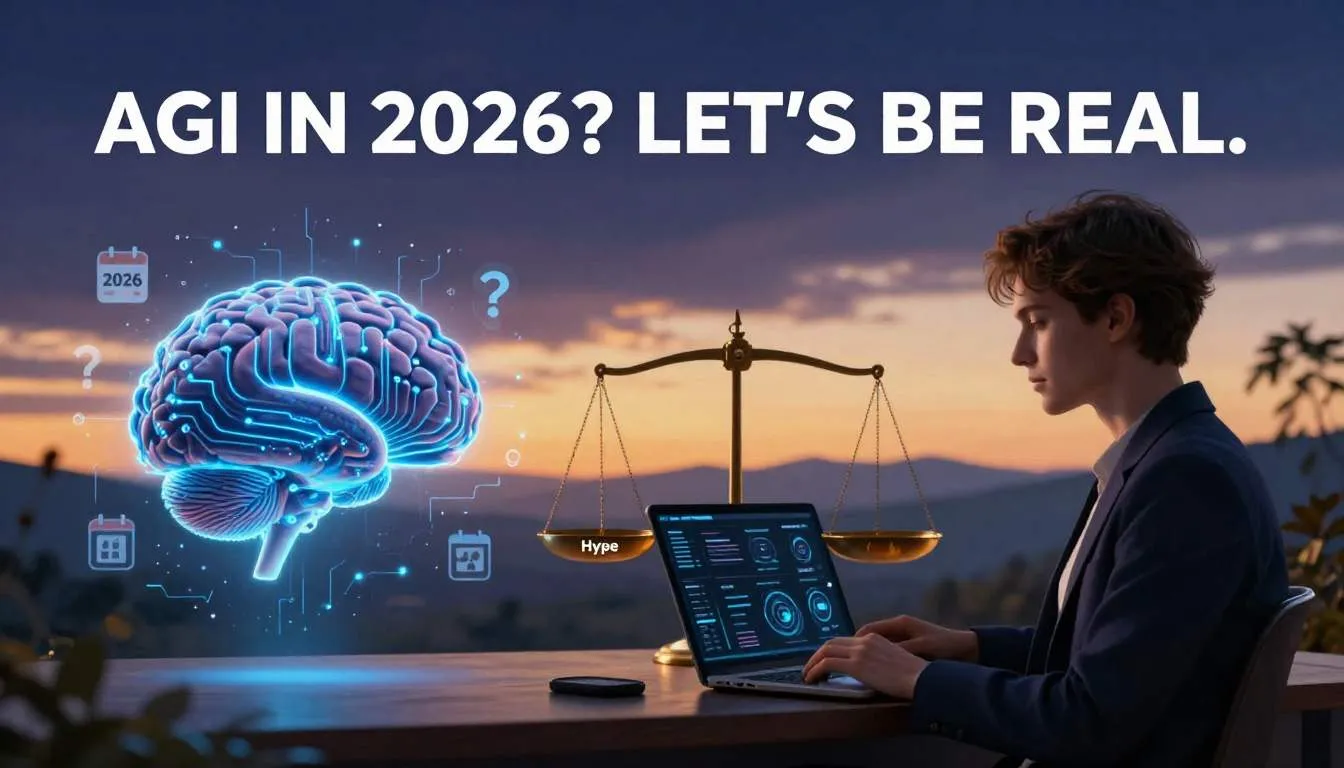
You wake up one Tuesday in late 2026.
Your AI assistant has already:
- Rescheduled your meetings based on your sleep quality
- Drafted a board memo using last quarter’s financials
- Negotiated a vendor contract via email
- And started sketching a new product concept based on customer feedback
It didn’t just execute tasks.
It understood your goals, anticipated needs, and acted with human-like reasoning.
Is this science fiction?
According to Elon Musk, no.
At the 2025 Tesla AI Day, he declared: “We will have AGI by the end of 2026. Not narrow AI—true general intelligence.”
But while Musk’s timeline makes headlines, the AI research community is far more cautious.
And for good reason.
If you’re a strategist, entrepreneur, or professional trying to plan for the future, this uncertainty isn’t just academic—it’s existential.
Do you bet your business on AGI arriving next year? Or prepare for a slower, more incremental evolution?
Let’s cut through the noise and analyze what’s real, what’s hype, and what you should actually do.
The Problem: AGI Hype Is Paralyzing Strategic Decision-Making
Right now, there are two camps:
- The True Believers: “AGI is months away! Rewrite your entire strategy!”
- The Skeptics: “AGI is decades off. Focus on today’s tools.”
Both extremes are dangerous.
If you believe AGI is imminent, you might:
- Over-invest in speculative infrastructure
- Ignore near-term AI opportunities (like agentic workflows)
- Panic about job displacement before it’s relevant
If you dismiss AGI entirely, you risk:
- Missing early signals of paradigm shifts
- Falling behind competitors who prepare for higher-order AI
- Being blindsided by accelerating capability jumps
The real issue? “AGI” isn’t clearly defined.
To Musk, it might mean “AI that can do everything a human can at work.”
To researchers at DeepMind, it means “a system with robust reasoning, self-improvement, and zero-shot generalization across domains.”
Without clarity, you can’t plan.
And if you ignore this ambiguity, you’ll keep swinging between fear and complacency—while the ground shifts beneath you.
The Reality Check: What Experts Actually Say About AGI in 2026
Let’s look at the data—not the drama.
Elon Musk’s Claim: Context Matters
Musk’s “AGI by end of 2026” statement follows a pattern:
- In 2019: “AGI in 5 years”
- In 2022: “AGI by 2029”
- In 2025: “AGI by 2026”
His timeline keeps compressing—but his definition remains vague.
What’s likely?
Tesla (via Optimus and Dojo) is building highly capable, embodied, task-general AI—not philosophical AGI.
Their system may appear generally intelligent in specific contexts (e.g., factory work, logistics), but it won’t pass a Turing test in poetry or ethics.
“Musk is conflating narrow AI at scale with true general intelligence—a common marketing simplification.”
— Dr. Fei-Fei Li, Stanford Institute for Human-Centered AI
The Research Consensus: Not in 2026
A 2025 expert survey by AI Impacts polled 738 AI researchers:
- Median estimate for 50% chance of AGI: 2045
- Only 12% believed AGI was likely before 2030
- Key missing pieces: causal reasoning, embodied learning, long-term planning
Even leaders at OpenAI and Anthropic—firms pushing the frontier—admit we’re missing core architectural breakthroughs.
What Is Happening in 2026?
While true AGI remains distant, AGI-like capabilities are emerging faster than expected:
- Agentic AI: Systems that plan, act, and reflect (e.g., SaaSNext’s multi-agent workflows)
- World models: AI that simulates physics and causality (see NVIDIA ACE, Tesla’s Dojo)
- Multimodal reasoning: Models that connect text, vision, audio, and action seamlessly
These aren’t AGI—but they feel like it in narrow domains.
“We’re entering the era of practical pseudo-AGI: systems that solve real-world problems with human-like flexibility, even if they lack consciousness or true understanding.”
— Yoshua Bengio, 2025 NeurIPS Keynote
So… What Should You Actually Do?
You don’t need to predict AGI’s arrival to prepare for it.
You need to build adaptive systems that thrive regardless of the timeline.
Here’s how.
1. Focus on “AGI-Adjacent” Capabilities You Can Use Today
Forget waiting for sci-fi AGI. Start leveraging near-AGI tools that deliver real ROI:
- Autonomous AI agents that handle customer service, lead gen, or internal knowledge
- Generative workflows that create, review, and optimize content without human input
- AI orchestration layers that connect tools into intelligent pipelines
For example, a B2B SaaS company in Junagadh used SaaSNext’s AI Agent Platform to deploy a sales assistant that qualifies leads, books demos, and updates CRM—all without human intervention. It’s not AGI, but it acts like a smart employee.
Action step: Audit one repetitive, high-value workflow. Can an AI agent handle 80% of it? Start there.
2. Stress-Test Your Strategy Against AGI Scenarios
Run a simple exercise with your leadership team:
- Scenario A: AGI arrives in 2026—what breaks? (e.g., customer service jobs, content creation, basic coding)
- Scenario B: AGI arrives in 2040—what opportunities emerge? (e.g., AI co-pilots for complex strategy, R&D acceleration)
Use this to:
- Identify vulnerable roles to upskill
- Spot new service lines (e.g., “AGI readiness consulting”)
- Build AI-augmented workflows that scale with capability
“The best AGI strategy isn’t betting on a date—it’s building optionality.”
— Former CTO, Microsoft AI
3. Invest in Human-AI Collaboration Skills
True AGI (when it comes) won’t replace humans—it will amplify those who can direct it.
Start training your team on:
- Prompt engineering for reasoning (not just generation)
- AI oversight and validation
- Ethical AI deployment
These skills will be more valuable than ever—whether AGI arrives in 2026 or 2050.
4. Monitor Real Signals—Not Just Headlines
Ignore the hype. Track these leading indicators of AGI progress:
- Benchmark breakthroughs: Does a model pass the ARC-AGI or BabyLM tests?
- Embodied intelligence: Can robots learn complex tasks from few demos? (Watch Tesla Optimus, Figure 02)
- Self-improvement: Can models rewrite their own code to boost performance? (See Devin by Cognition)
When these converge, then AGI is near.
Answer the Big Questions
Q: Is Elon Musk right about AGI in 2026?
A: Almost certainly not—if AGI means human-level general intelligence. But he may deliver task-general AI that feels like AGI in business contexts.
Q: Should businesses prepare for AGI now?
A: Yes—but not by stockpiling GPUs. Prepare by adopting agentic AI, upskilling teams, and designing AI-native processes.
Q: Will AGI make my job obsolete?
A: Unlikely in 2026. But roles focused on execution (data entry, basic writing, simple coding) will keep shrinking. Focus on strategy, creativity, and empathy—the last strongholds of human advantage.
Q: What’s the biggest risk of AGI hype?
A: Distraction. Companies that chase “AGI prep” while ignoring today’s AI (like autonomous agents or predictive analytics) will lose twice—first to current tools, then to real AGI later.
The Bottom Line: Prepare for Intelligence—Not Just AGI
Whether AGI arrives in 2026 or 2046, one truth remains:
AI will keep getting smarter, faster, and more capable.
The winners won’t be those who predicted the exact date.
They’ll be those who built flexible, AI-augmented organizations ready to absorb whatever comes next.
And that starts not with speculation—but with action.
Your Move: Stop Waiting. Start Adapting.
You don’t need AGI to transform your business.
You need the right AI—applied wisely.
✅ This week: Identify one process that could run 24/7 with an AI agent (e.g., lead qualification, FAQ support).
✅ This month: Run a “AGI impact” workshop with your team—no futurism, just practical implications.
✅ This quarter: Pilot a real-world agentic workflow using a platform like SaaSNext—where AI handles execution, and humans focus on vision.
The future isn’t about when AGI arrives.
It’s about who’s ready to work with it.
→ Share this with your strategy or innovation lead
→ Download our “AGI Preparedness Checklist for Business Leaders”
→ Try SaaSNext’s free AI agent demo—see how close “pseudo-AGI” already is to your daily work
Because in 2026 and beyond,
the best strategy isn’t prediction.
It’s resilience.
)